Showing posts with label Dieppe. Show all posts

Wednesday, July 9, 2014

beach combing and digression: the white stone of happiness

Amédée Rosier, Mussel Picking at Low Tide, Environs of Trouville (or Shrimp Fishing, Sunset) 1868. Musée d'Orsay. Detail.
Walking a beach in Normandy and repeating what Agnès Varda termed the “modest gesture of stooping to glean," a French peasant woman might be observed, painted and described by a visitor whose vacation there was defined by not working, by not looking at the shore for sustenance. 


Writing about a painting by Elodie La Villette recently, I suggested that a figure in the painting might be a female rock-picker, and this led me to further think about what it means to look and interpret, and misinterpret, and romanticize what you are seeing when you take the time to look at something new-- when you are away from your everyday existence and your only task for the day is to absorb new information.

Francis Tattegrain,  Wreck Scavenger, c. 1880.


A gleaner of the shore might be looking for shellfish, flint, or even -- as some folklorists described, looking for the elusive stone of happiness.


According to several 19th-century travel writers and folklorists, fisherfolk from the Le Pollet quarter of Dieppe believed that a certain white stone, found on the beach, might bring happiness and good luck.  


One of the earliest accounts of this, in Excursions in Normandy (1841) by travel writers Jacob Venedey and Frederic Shoberl, states that “the girls of Pollet have a superstitious notion of a different kind. These seek upon the beach a white stone of a particular shape, which they call la pierre du bonheur, and to which they ascribe the power of conferring prosperity, delivering them from danger, and bringing them in due time a good husband." As did many visitors to the Brittany and Normandy coast, Venedey and Shoberl interpret the popular practices of the nineteenth-century Normans they encountered as authentic remains of ancient culture, noting that "how many thousand years old this practice is the gods of Gaul might perhaps be able to tell.”  

Superstitions, costumes and religious practices were avidly collected and catalogued by 19th century travellers. Folklorists (like Anatole Le Braz, Charles Le Goffic and Paul Sébillot in Brittany) often read folk-belief as a form of resistance to the church's official control of belief: as an independent (yet superstitious and primitive) survival of local culture.


Portrait of Amélie Bosquet (source: http://melao.free.fr/amelie_bosquet.html)


Amélie Bosquet was an ardent feminist and writer on folklore and regional culture in Normandy (she was a native of Rouen). She repeats Venedey and Shoberl's story of the white stone of happiness in her travel text, La Normandie romanesque et merveilleuse (1845). Bosquet was interested in the persistent cult of "Druidical" stones attributed to women in Brittany, who believed that certain dolmen, or standing stones, might confer fertility upon formerly sterile women who touched or danced around them.  For her, the recently collected Dieppe tale seemed to confirm the continuing validity of this association, noting that "It appears... that the gods embedded in the stone were favorable to marriage; here is a new proof" (176-7).
Dance around the Menhir at Plonéour-Lanvern on the Day of the Pardon

Venedey and Shoberl and Bosquet are also cited by painter turned folklorist Paul Sébillot in Folklore des Pecheurs (1901) in recounting a version of the "white stone of happiness" as he notes that "it is very rare for a fisherman to marry a country girl, for a fisherman's wife must be able to help her husband with his craft." Like peasants of the land, he notes, fisherwomen try to discern, via superstitious means, whether or not they will be soon to marry.
 
Folklorist David Hopkin, in his recent book Voices of the People, argues that historians should pay attention to the ways that the telling of folklore gave rural people agency to "express, in their own language, their sense of place" and communicate "from one generation to the next knowledge of their communities"(17). Even though the voices of those who do not directly tell their own stories will always be filtered, or mediated, there is great appeal to viewing peasant women, to some degree, as "agents in their own lives" (18) instead of as well-worn types or as "construction[s] of French literary and political culture... the 'other' against which France defined itself (18).

  Hopkin's work on fisher-folklore asserts that folktales often speak of social relations, and perhaps this tale tells us something of women's life experiences on the coast. The female beachcomber, the peasant fisher-girl, who gleans the strand for the stone that is there to be found, the one that will guide her future. In their communities, fisher women had social positions that differed greatly from the female peasants of the land. Women of the Atlantic coast often sold the fish caught by the men, controlled the family's money, tended to have greater rights to inheritance, and sometimes (as on the Breton islands) were the ones who chose their husbands (and not the reverse).


 Venedey and Shoberl, the ones who first mention the white stone of happiness,  comment on the "masculinity" of the women of Pollet that they
Ulysses Butin, The Fisherman's Wife: Normandy Coast.  Engraving in the catalog of the Salon of 1879.


"are a distinct genus.  They are perhaps more men than their husbands.  During the absence of the latter, the whole management of the house is in their hands, and they seldom resign it when the men return. It is they who sell the fish that are caught, and thus come in contact with the people of Dieppe, who are further advanced in civilization; hence they soon attain a higher step than their husbands, and so have a right to wield the sceptre. It is they who drag the fishing-boats into and out of harbour; and they share with their husbands many other laborious occupations, which serve to fortify their bodies.
Jules and Louis Séeberger, Fish Selllers at Dieppe, 1901.

Their masculine habits give them a relish for the pleasures of the men: they never miss their treats and their parties, and sing their song and take their glass with as much glee as their companions of the ruder sex. This somewhat barbarous custom, however, is attended with these good effects, that man and wife more rarely quarrel, that the latter cannot  reproach the former with spending all he gets in drink, and that they return home together, and at a very early hour. Let him who wishes to keep a  whole skin beware of picking a quarrel with these he-women; for there is no joking with them: but  to the Parisian dames who sigh for the emancipation  of the sex, I can give no better advice than to marry a Polletais" (154).

Was the story of the stone a way of talking about a woman's agency in finding a partner? Does it optimistically offer the notion that love is there if you look, that it is as common as a stone, or that careful looking sorts the special from the ordinary… or that love is a magical gift from the sea? 

Or was this story, seemingly repeated from one source in 1841, merely the daydream of a beach-goer?  

I don't mean to draw a conclusion here, and I have no background in folklore. But by reading David Hopkin's work on folklore and the voices of rural people, historians of visual culture may be given some critical tools that help us out of the bind that we get into when we consider all 19th-century representations of the rural as urban-based discourses on modern life. 


Further notes: 

A fully-embellished, sentimental version of "The White Stone of Happiness" appears in the 1912 collection of Fairy Tales by Lilian Gask, The Fairies and the Christmas Child. 
 
Here, the stone is spit up on the strand by a mermaid.


'I have lost my Etienne's heart for ever, for ever,' she wailed, 'unless I can find the White Stone of Happiness, which a mermaid throws from the depths of the sea once in a thousand years. I may search for months, and never find it; and Etienne holds aloof from me, and grows further away each day.' 
Now just at her feet lay a small white stone, smooth and round as a Fairy's plaything. I picked it up and showed it to her. 


Lilian Gask "Chapter V: The white Stone of Happiness."  


Sunday, May 11, 2014

Elodie La Villette on a rocky strand


Elodie La Villette, Chemin du Bas Fort Blanc, Dieppe, 1885,  Musée de Morlaix 
(photo taken by the author in 2014 with permission)
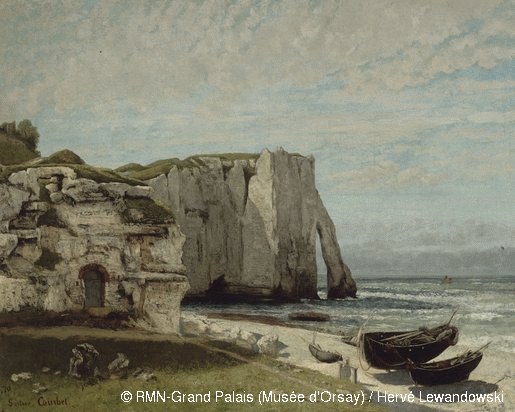
One of the many great paintings owned by the Musée de Morlaix (the permanent collection has been closed for several years),  is this coastal landscape by Elodie la Villette that will soon be coming out of storage for a summer exhibition at the Musée des Jacobins (Morlaix, June 14 to October 31,  2014), Elodie La Villette et Caroline Espinet : regards croisés de deux soeurs.  La Villette was a remarkable artist. She was born in Strasbourg, but spent most of her life in Brittany, in Lorient and on the Quiberon peninsula, in Portivy. La Villette studied with several prominent painters, including Corot, and she emulated many of Courbet's techniques, and especially admired his paintings of the Normandy coast from the 1860s-1870.
Gustave Courbet, The Cliffs at Etretat after a Storm 1870, Musée d'Orsay

 Her Salon debut was in 1870, and in 1875 she won a third-class medal. Over the course of her very successful career, she showed in London, Barcelona, Munich, Copenhagen, Chicago, Vienna, Namur, Amsterdam, Manchester, Ghent, and Brussels. In the 1870s and 80s, she was the only woman artist showing large-scale landscapes at the Paris Salons. La Villette also showed yearly with the Union des Femmes Peintres et Sculpteurs, the first exhibition society for women artists.  Typical of the backhanded compliment that women artists often received, critic Henri Olleris in 1880 wrote of her work at the Palace of Industry in Paris that it showed a 

completely virile talent.  There is no trace of feminine weakness in these paintings. The land is solid, the horizons are distant, the sea is full of movement. The first impression produced, which is true, is that of a great sincerity and a great finesse of observation.   These qualities, combined with a skill of execution, brings to light these works that most justly appreciated. 

"No feminine weakness": such was the sort of praise one could only hope for as a woman who painted landscape and seriously engaged with the challenge of evoking a place. La Villette, especially in this painting, did not subscribe to a notion of feminine weakness-- quite the reverse.

Pouring over details from this remarkable landscape, and returning to photos I took on the beach, very near Dieppe, in 2012, I would like to explore the relationships in this painting between the small human figures and use some Rachel Carson's very poetic observations about marine biology in regard to what she termed the “interchangability of land and sea in this marginal world of the shore.”

The white chalk cliffs at Dieppe (on the left) attracted many artists in the mid-to late 19th century, as tourism grew on the Normandy coast.  Antoine Guillemet, a painter who was a student of Corot and Daubigny and later close friends with Emile Zola, Claude Monet and Paul Cézanne exhibited large-scale, crowd-pleasing seascapes such as this image of the white cliffs of Puy and tidal areas of the beach near Dieppe in the Salons of the 1870s. Guillemet, like La Villette,  never embraced the heightened pallete or completely broken brushstroke of Monet's Impressionism, preferring the open-air, sketch aesthetic of the Romantics and Realists.


Jean-Baptiste Antoine Guillemet, The Cliffs of Puys at Low Tide, 1877, Chateau Museum, Dieppe


In the 1830s, like La Villette, romantic-era landscapist Eugène Isabey was interested in the life of those who work on the beach-- he includes a fisherman's shack and a wooden cart at the base of the cliffs.


Eugène Louis Gabriel Isabey, Le château de Dieppe (vu du bas de la falaise) (1830s?)


The rude life of those who  worked on the shore, and  lived in the fishermen's quarter of Le Pollet  was a staple of painting and popular illustration in the earlier nineteenth century.

Corot, Fisherman's Wife, Dieppe c.1822


A. Bayol, Dieppe, 1846
Le Pollet "Les Gobes", 1771


From an early 19th century series
of engravings of the fisherpeople
 of Le Pollet, the fisherman's quarter of Dieppe.


Cliff dwellers in "les Gobes," Dieppe


The description of these regional "types" was also a staple of later post card photographers who sought out the cliff-dwelling fishers who lived so rudely, yet so close to the large port and fashionable beach of Dieppe. Some of these fisherfolk had been displaced from Le Pollet during the nineteenth-century industrial overhaul of the harbor.  Some of the caves in the cliffs were abandoned stone quarries.


Fishers' home in the cliff.


The practice of re-using fishing boats as sheds or shacks seemed likewise a fascinating example of peasant thrift and economy.


Further up the coast, in Equihen, near Boulogne-sur-Mer, fishermen made homes called "quilles en l'air" with the no-longer seaworthy boats turned upside down, (today these are holidays cottages). Evincing the same fascination with peasant thrift and filth that I have written about in an earlier post, much of this imagery posits the fishers as ekeing out an existence on the margins of a place in the process of change.


Fishing family living in a home made from an overturned wooden boat know as "Quille en l'air," Boulogne sur Mer.


 La Villette, Chemin du Bas Fort Blanc, detail.
Returning to La Villette's painting, I would like to look closely at her interest in this strip of coastline and the human and ecological life depicted there. Villette does depict the strand as inhabited, but she does not dwell on this aestheticization of poverty or romantic primitivism. 

detail


 Right at the edge of the sea are two barely visible figures, bent over, arms madly working. Are these children playing? People digging for shellfish or cutting seaweed exposed by the low tide? 

detail


 To the right of the ship (traveling along on the horizon line) is another group of  three figures (one may be a child) and further right, by a small boat are two more; one holds a red parasol. Are the two on the left part of a small boating party on the right? Like Monet,  La Villette's staffage figures invite a curious eye as they depict recognizable gestures using a bare economy of means. La Villette’s marine landscapes often include human presences in the form of small figures in the foreground or staffage figures at a distance but they draw no hard distinctions between the life of those on the shore and on the water, often including those figures who linger to look as well as those who work the low tide, gathering shellfish and seaweed at its ebb.
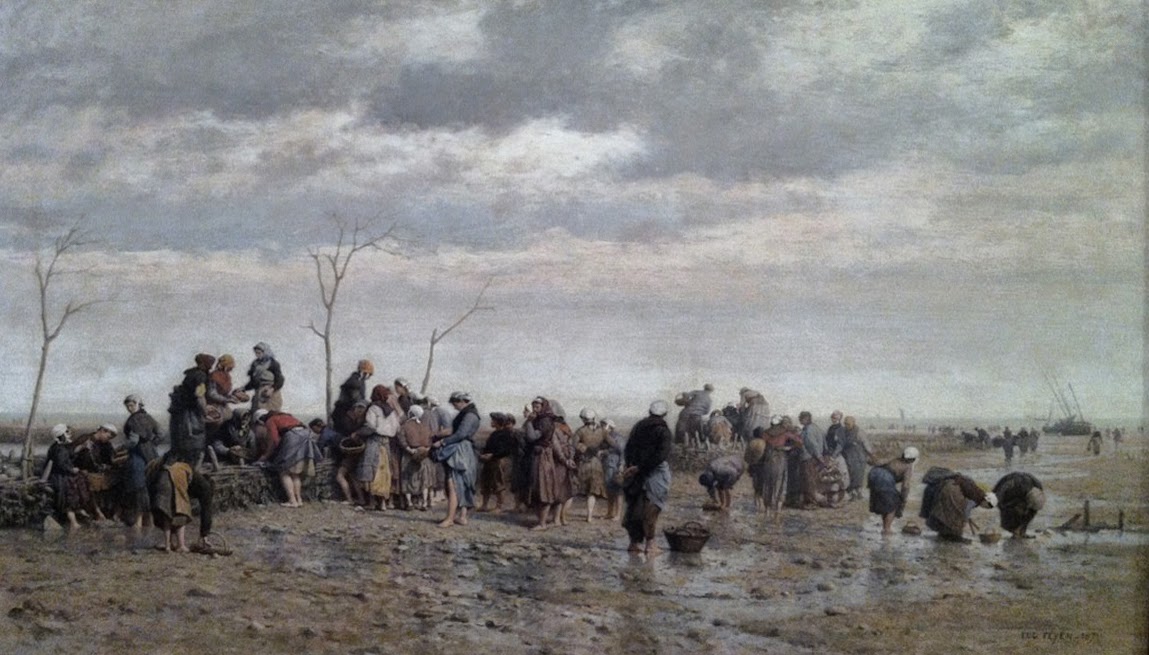
Her figures do not loom large above the horizon, as they do so often in Jules Breton’s heroic paintings. There is no room for anecdote or rags as in the images of fishers above.  Even in comparison to Eugène Feyen's Gleaners of the Sea, which is packed with the silhouettes and postures of working in the intertidal world, La Villette's forms are less anecdotal, and do not break the horizon.


Eugène Feyen, Gleaners of the Sea, 1871


The most prominent figure in her Dieppe painting is a mostly black outline of a female figure (in a dark dress and white kerchief or coiffe) with a square shape behind her back.


 La Villette, Chemin du Bas Fort Blanc, detail.


detail
In the catalog Impressions of France (1996), John House suggested that "this is a typical image of the Normandy beaches, with the figure of a woman carrying a mussel-fishing basket, and nets handing on posts behind her."

 Ulysses Butin was a naturalist painter much admired by Vincent Van Gogh, who often represented genre scenes of coastal peasants.  In this painting (that recently showed up on the art market) he depicted women returning from picking mussels with their baskets.


Late nineteenth and early twentieth century postcards depict women of Normandy and the Channel coast carrying mussels in baskets on their arm (like Butin and Corot's painting above) and on their backs.  However, the baskets are not worn higher than their heads and nets have nothing to do with mussel picking.


Nets were used for shrimp fishing, and this too was a favorite subject for artists and photographers.


But there is something else that Villette's woman might be collecting, that would lend a very interesting subject to this painting:  this woman walking the beach at low tide, among the stones on the shore, rather than among the large rocks farther out where mussels grow, may be a rock picker.

Flint in chalk cliffs.  source: http://craies.crihan.fr/?page_id=36

The chalk cliffs of this section of Normandy beaches were formed by the high yet shallow seas of the Cretaceous period (which gets its name from the chalk deposits laid down during this era). Carson,  in The Sea Around Us  (1951) discusses the layering of flint stones these cliffs and their poetic temporal resonance:


the chalk seems to be a shallow-water deposit, but it is so pure in texture that the surrounding lands must have been low deserts, from which little material was carried seaward. Grains of wind-borne quartz sand, which frequently occur in the chalk, support this view. At certain levels the chalk contains nodules of flint. Stone Age men mined the flint for weapons and tools and also used this relic of the Cretaceous sea to light their fires.


This somewhat loose sediment is shot through with seams and nodules of black flint (silex in French). Because of erosion, flint falls from the soft chalk cliff and becomes gradually rounded by the action of waves into hard, dark stones-- known in the area as "galets." 


gathering stones at Le Tréport, 1920s


Women collected the rounded rocks in baskets carried on their backs.  Horses then pulled the heavy cartloads or transported large bins of stones from the beach.  


In the Middle Ages, these flint stones had been used as projectiles. Many homes in Dieppe, Le Tréport and other towns in the area are made of these hard stones.
 
Detail of a building in Le Tréport showing flint in concrete.


 In more recent times they were exported to England and the US (sometimes as ballast) and were also ground down for use in cosmetics, medications and ceramics (a certain type of the sought after black stones were used by Wedgewood). Large scale collection of these stones for sale began in the late 18th century and was widespread by the time La Villette was working. Collection of "galets" was banned in 1985 (although in Cayeux sur Mer in Picardie, beach stones are collected en masse and industrially polished for a range of uses.  The recent film Bord de Mer (2002) is set there.)


Bas Fort Blanc. from http://www.estrancitedelamer.fr/

flint nodules in the cliff
foreground, detail
 The horizontal rocky strand of the beach is a result of the falling away of these vertical cliffs, laid down 100 million years ago. The center line of white in this painting is the limestone footings of previous cliffs that now lie in the tideline. 

Beyond them, to the right, are rocks covered in the green algae and seaweed of deeper water and shorter exposure to the air. 

The time of the diurnal tides meets the time of labor, the time of vacation, the deep time of sedimentation and rapid erosion.  As Carson wrote in the opening to her second sea book, The Edge of the Sea:

The edge of the sea is a strange and beautiful place. All through the long history of Earth it has been an area of unrest where waves have broken heavily against the land, where the tides have pressed forward over the continents, receded and then returned. For no two successive days is the shore line precisely the same. Not only do the tides advance and retreat in their eternal rhythms, but the level of the sea itself is never at rest. It rises or falls as the glaciers melt or grow, as the floor of the deep ocean basins shifts under its increasing load of sediments, or as the earth's crust along the continental margins warps up or down in adjustment to strain and tension. Today a little more land may belong to the sea, tomorrow a little less. Always the edge of the sea remains an elusive and indefinable boundary.

on the edge of a few tidal pools are newly fallen, black stones that  litter the foreground of the painting, right in the path of the woman who heads toward us. 


Gustave Courbet, Laundresses at Low Tide (known as The Seaweed Gatherers), 1866-68.
Clark Art Institute, Williamstown.


Courbet, The Cliffs at Etretat after a Storm 1870, detail.

Like Courbet's paintings of Etretat, La Villette finds the shore occupied with human life. He had included miniscule laundresses washing clothing at the fresh water springs that rose up in the sand at low tide. 


Laundresses at Etretat, from a vintage postcard.


La Villette shows us many small figures, but the woman who may be a rock picker bears a very heavy burden in her harvest of stones.This was surely "no feminine weakness."


La Villette, detail


Afterthought:  After finishing this post, I found this image of a "Mussel Fisher" by Concarneau artist Alfred Guillou (but do not know why a mussel-picker would have a shrimping net).

Another afterthought: La Villette probably knew of this celebrated Salon painting (often mistakenly labeled "chicken woman" in English), whose eroticization of a fisherwoman could not be more distant from her artistic practice.

Antoine Vollon, Woman of Le Pollet at Dieppe, Salon of 1876