Showing posts with label Elodie la Villette. Show all posts

Sunday, May 11, 2014

Elodie La Villette on a rocky strand


Elodie La Villette, Chemin du Bas Fort Blanc, Dieppe, 1885,  Musée de Morlaix 
(photo taken by the author in 2014 with permission)
One of the many great paintings owned by the Musée de Morlaix (the permanent collection has been closed for several years),  is this coastal landscape by Elodie la Villette that will soon be coming out of storage for a summer exhibition at the Musée des Jacobins (Morlaix, June 14 to October 31,  2014), Elodie La Villette et Caroline Espinet : regards croisés de deux soeurs.  La Villette was a remarkable artist. She was born in Strasbourg, but spent most of her life in Brittany, in Lorient and on the Quiberon peninsula, in Portivy. La Villette studied with several prominent painters, including Corot, and she emulated many of Courbet's techniques, and especially admired his paintings of the Normandy coast from the 1860s-1870.
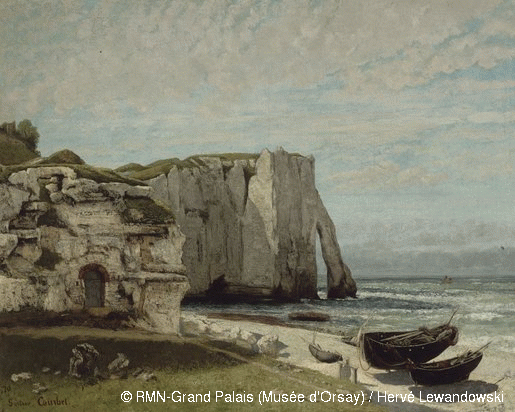
Gustave Courbet, The Cliffs at Etretat after a Storm 1870, Musée d'Orsay

 Her Salon debut was in 1870, and in 1875 she won a third-class medal. Over the course of her very successful career, she showed in London, Barcelona, Munich, Copenhagen, Chicago, Vienna, Namur, Amsterdam, Manchester, Ghent, and Brussels. In the 1870s and 80s, she was the only woman artist showing large-scale landscapes at the Paris Salons. La Villette also showed yearly with the Union des Femmes Peintres et Sculpteurs, the first exhibition society for women artists.  Typical of the backhanded compliment that women artists often received, critic Henri Olleris in 1880 wrote of her work at the Palace of Industry in Paris that it showed a 

completely virile talent.  There is no trace of feminine weakness in these paintings. The land is solid, the horizons are distant, the sea is full of movement. The first impression produced, which is true, is that of a great sincerity and a great finesse of observation.   These qualities, combined with a skill of execution, brings to light these works that most justly appreciated. 

"No feminine weakness": such was the sort of praise one could only hope for as a woman who painted landscape and seriously engaged with the challenge of evoking a place. La Villette, especially in this painting, did not subscribe to a notion of feminine weakness-- quite the reverse.

Pouring over details from this remarkable landscape, and returning to photos I took on the beach, very near Dieppe, in 2012, I would like to explore the relationships in this painting between the small human figures and use some Rachel Carson's very poetic observations about marine biology in regard to what she termed the “interchangability of land and sea in this marginal world of the shore.”

The white chalk cliffs at Dieppe (on the left) attracted many artists in the mid-to late 19th century, as tourism grew on the Normandy coast.  Antoine Guillemet, a painter who was a student of Corot and Daubigny and later close friends with Emile Zola, Claude Monet and Paul Cézanne exhibited large-scale, crowd-pleasing seascapes such as this image of the white cliffs of Puy and tidal areas of the beach near Dieppe in the Salons of the 1870s. Guillemet, like La Villette,  never embraced the heightened pallete or completely broken brushstroke of Monet's Impressionism, preferring the open-air, sketch aesthetic of the Romantics and Realists.


Jean-Baptiste Antoine Guillemet, The Cliffs of Puys at Low Tide, 1877, Chateau Museum, Dieppe


In the 1830s, like La Villette, romantic-era landscapist Eugène Isabey was interested in the life of those who work on the beach-- he includes a fisherman's shack and a wooden cart at the base of the cliffs.


Eugène Louis Gabriel Isabey, Le château de Dieppe (vu du bas de la falaise) (1830s?)


The rude life of those who  worked on the shore, and  lived in the fishermen's quarter of Le Pollet  was a staple of painting and popular illustration in the earlier nineteenth century.

Corot, Fisherman's Wife, Dieppe c.1822


A. Bayol, Dieppe, 1846
Le Pollet "Les Gobes", 1771


From an early 19th century series
of engravings of the fisherpeople
 of Le Pollet, the fisherman's quarter of Dieppe.


Cliff dwellers in "les Gobes," Dieppe


The description of these regional "types" was also a staple of later post card photographers who sought out the cliff-dwelling fishers who lived so rudely, yet so close to the large port and fashionable beach of Dieppe. Some of these fisherfolk had been displaced from Le Pollet during the nineteenth-century industrial overhaul of the harbor.  Some of the caves in the cliffs were abandoned stone quarries.


Fishers' home in the cliff.


The practice of re-using fishing boats as sheds or shacks seemed likewise a fascinating example of peasant thrift and economy.


Further up the coast, in Equihen, near Boulogne-sur-Mer, fishermen made homes called "quilles en l'air" with the no-longer seaworthy boats turned upside down, (today these are holidays cottages). Evincing the same fascination with peasant thrift and filth that I have written about in an earlier post, much of this imagery posits the fishers as ekeing out an existence on the margins of a place in the process of change.


Fishing family living in a home made from an overturned wooden boat know as "Quille en l'air," Boulogne sur Mer.


 La Villette, Chemin du Bas Fort Blanc, detail.
Returning to La Villette's painting, I would like to look closely at her interest in this strip of coastline and the human and ecological life depicted there. Villette does depict the strand as inhabited, but she does not dwell on this aestheticization of poverty or romantic primitivism. 

detail


 Right at the edge of the sea are two barely visible figures, bent over, arms madly working. Are these children playing? People digging for shellfish or cutting seaweed exposed by the low tide? 

detail


 To the right of the ship (traveling along on the horizon line) is another group of  three figures (one may be a child) and further right, by a small boat are two more; one holds a red parasol. Are the two on the left part of a small boating party on the right? Like Monet,  La Villette's staffage figures invite a curious eye as they depict recognizable gestures using a bare economy of means. La Villette’s marine landscapes often include human presences in the form of small figures in the foreground or staffage figures at a distance but they draw no hard distinctions between the life of those on the shore and on the water, often including those figures who linger to look as well as those who work the low tide, gathering shellfish and seaweed at its ebb.
Her figures do not loom large above the horizon, as they do so often in Jules Breton’s heroic paintings. There is no room for anecdote or rags as in the images of fishers above.  Even in comparison to Eugène Feyen's Gleaners of the Sea, which is packed with the silhouettes and postures of working in the intertidal world, La Villette's forms are less anecdotal, and do not break the horizon.
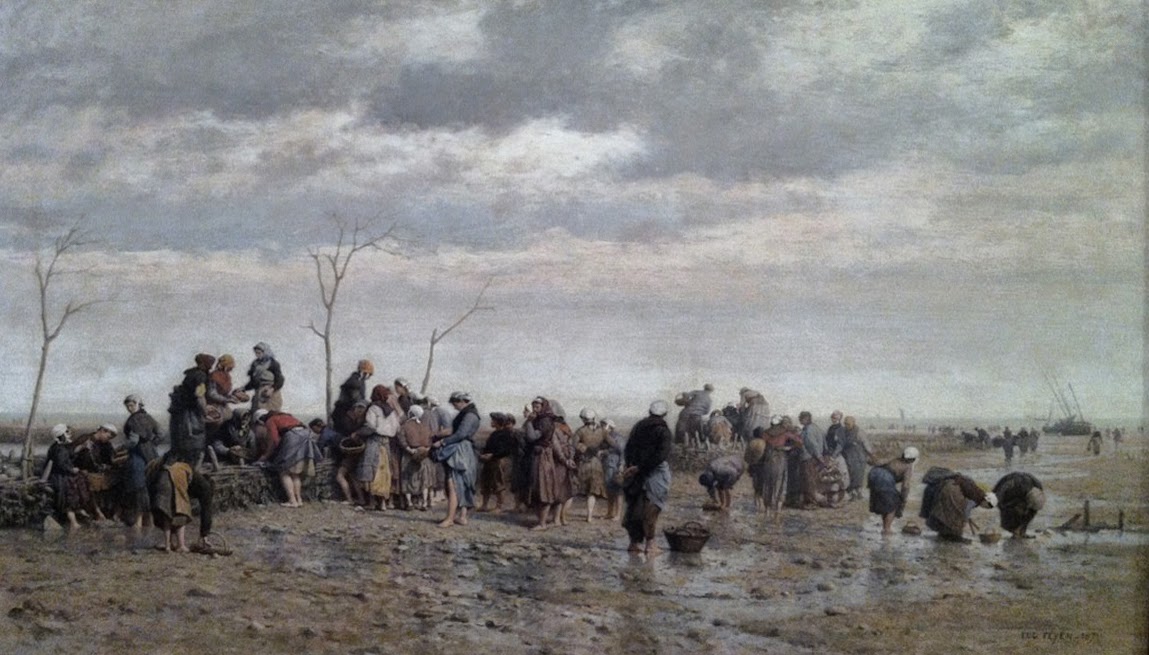

Eugène Feyen, Gleaners of the Sea, 1871


The most prominent figure in her Dieppe painting is a mostly black outline of a female figure (in a dark dress and white kerchief or coiffe) with a square shape behind her back.


 La Villette, Chemin du Bas Fort Blanc, detail.


detail
In the catalog Impressions of France (1996), John House suggested that "this is a typical image of the Normandy beaches, with the figure of a woman carrying a mussel-fishing basket, and nets handing on posts behind her."

 Ulysses Butin was a naturalist painter much admired by Vincent Van Gogh, who often represented genre scenes of coastal peasants.  In this painting (that recently showed up on the art market) he depicted women returning from picking mussels with their baskets.


Late nineteenth and early twentieth century postcards depict women of Normandy and the Channel coast carrying mussels in baskets on their arm (like Butin and Corot's painting above) and on their backs.  However, the baskets are not worn higher than their heads and nets have nothing to do with mussel picking.


Nets were used for shrimp fishing, and this too was a favorite subject for artists and photographers.


But there is something else that Villette's woman might be collecting, that would lend a very interesting subject to this painting:  this woman walking the beach at low tide, among the stones on the shore, rather than among the large rocks farther out where mussels grow, may be a rock picker.

Flint in chalk cliffs.  source: http://craies.crihan.fr/?page_id=36

The chalk cliffs of this section of Normandy beaches were formed by the high yet shallow seas of the Cretaceous period (which gets its name from the chalk deposits laid down during this era). Carson,  in The Sea Around Us  (1951) discusses the layering of flint stones these cliffs and their poetic temporal resonance:


the chalk seems to be a shallow-water deposit, but it is so pure in texture that the surrounding lands must have been low deserts, from which little material was carried seaward. Grains of wind-borne quartz sand, which frequently occur in the chalk, support this view. At certain levels the chalk contains nodules of flint. Stone Age men mined the flint for weapons and tools and also used this relic of the Cretaceous sea to light their fires.


This somewhat loose sediment is shot through with seams and nodules of black flint (silex in French). Because of erosion, flint falls from the soft chalk cliff and becomes gradually rounded by the action of waves into hard, dark stones-- known in the area as "galets." 


gathering stones at Le Tréport, 1920s


Women collected the rounded rocks in baskets carried on their backs.  Horses then pulled the heavy cartloads or transported large bins of stones from the beach.  


In the Middle Ages, these flint stones had been used as projectiles. Many homes in Dieppe, Le Tréport and other towns in the area are made of these hard stones.
 
Detail of a building in Le Tréport showing flint in concrete.


 In more recent times they were exported to England and the US (sometimes as ballast) and were also ground down for use in cosmetics, medications and ceramics (a certain type of the sought after black stones were used by Wedgewood). Large scale collection of these stones for sale began in the late 18th century and was widespread by the time La Villette was working. Collection of "galets" was banned in 1985 (although in Cayeux sur Mer in Picardie, beach stones are collected en masse and industrially polished for a range of uses.  The recent film Bord de Mer (2002) is set there.)


Bas Fort Blanc. from http://www.estrancitedelamer.fr/

flint nodules in the cliff
foreground, detail
 The horizontal rocky strand of the beach is a result of the falling away of these vertical cliffs, laid down 100 million years ago. The center line of white in this painting is the limestone footings of previous cliffs that now lie in the tideline. 

Beyond them, to the right, are rocks covered in the green algae and seaweed of deeper water and shorter exposure to the air. 

The time of the diurnal tides meets the time of labor, the time of vacation, the deep time of sedimentation and rapid erosion.  As Carson wrote in the opening to her second sea book, The Edge of the Sea:

The edge of the sea is a strange and beautiful place. All through the long history of Earth it has been an area of unrest where waves have broken heavily against the land, where the tides have pressed forward over the continents, receded and then returned. For no two successive days is the shore line precisely the same. Not only do the tides advance and retreat in their eternal rhythms, but the level of the sea itself is never at rest. It rises or falls as the glaciers melt or grow, as the floor of the deep ocean basins shifts under its increasing load of sediments, or as the earth's crust along the continental margins warps up or down in adjustment to strain and tension. Today a little more land may belong to the sea, tomorrow a little less. Always the edge of the sea remains an elusive and indefinable boundary.

on the edge of a few tidal pools are newly fallen, black stones that  litter the foreground of the painting, right in the path of the woman who heads toward us. 


Gustave Courbet, Laundresses at Low Tide (known as The Seaweed Gatherers), 1866-68.
Clark Art Institute, Williamstown.


Courbet, The Cliffs at Etretat after a Storm 1870, detail.

Like Courbet's paintings of Etretat, La Villette finds the shore occupied with human life. He had included miniscule laundresses washing clothing at the fresh water springs that rose up in the sand at low tide. 


Laundresses at Etretat, from a vintage postcard.


La Villette shows us many small figures, but the woman who may be a rock picker bears a very heavy burden in her harvest of stones.This was surely "no feminine weakness."


La Villette, detail


Afterthought:  After finishing this post, I found this image of a "Mussel Fisher" by Concarneau artist Alfred Guillou (but do not know why a mussel-picker would have a shrimping net).

Another afterthought: La Villette probably knew of this celebrated Salon painting (often mistakenly labeled "chicken woman" in English), whose eroticization of a fisherwoman could not be more distant from her artistic practice.

Antoine Vollon, Woman of Le Pollet at Dieppe, Salon of 1876


Wednesday, July 24, 2013

seaweed

“"There are heroes in the seaweed. There are children in the morning."
--Suzanne, Leonard Cohen. 


I have always had a thing for seaweed.  And I tend to photograph it on almost every beach. 
Stepping into a Tidal Pool at Ruguénez, Brittany, 2006.  

Something about this photo kept my attention: I kept it on my computer screen for a few years, lurking behind a clutter of file icons. Perhaps it's the embodied sensation of stepping into this pool, looking into its indefinite depths, yet distracted by the reflection of me taking this picture that floats on the surface.


A tidal pool near Doonbeg, Co. Clare, Ireland, 2007

And here, too, clarity comes from shadow. Where my shadow falls, like the shadow of the rocks, there is a clear view to the sand below the surface. 

On a new beach, there is the lure of unknown tidal pools, where, along with other sea-life, seaweed forms are framed by the collaboration of rocks and the retreating sea. They are a sort of landscape, or nature-assemblage, that you apprehend from above as you hop along the exposed rocks.


A tidal pool near Doonbeg, Co. Clare, Ireland, 2007

Portivy, June 2013


 Alexandre Séon, La sirene (The Mermaid) 1896.  Musée d’Art Moderne-Saint-Étienne


The intertidal zone is a place of hybrid creatures and sea-people such as the selkies who shed their seal skins to become almost human, or the mermaids who haul out on the rocks. Brittany, like many other Atlantic Celtic places, had its version of mermaid myths: Anatole Le Braz's short story "Le Sang de la Sirène" (The Mermaid's Blood, 1901) tells of the cursed fishermen of the Isle of Sein who suffer the consequences of a mermaid being kept as a wife by an island man. Symbolist painter Alexandre Séon wreathes his siren in sensuous kelp, whose fronds mimic the shape of the waves and the color of her tail. The reddish brown is picked up again on the red sails of a Breton sardine boat that catches her attention.

But seaweed can also be disgusting: when I slip on its slime trying to get to the water, when its fishy damp rotting smell is drawing flies, it seems somewhere between animal and vegetable. It catches other things up in it—and lies tangled on the strand in impure piles that combine waste of many forms in uncanny assortment.  Hiding moisture under its top crust, it reanimates, changes color and is again viscous with each tide. I look up references to seaweed on Cape Cod: descriptions of popular sandy beaches tout the absence of seaweed on the shore. Pure sand: the prim beach aesthetic mimics the shaven beach body, scraped clean of nature.

Jules Michelet describes (with horror) a vast spectacle of rotten seaweed in his widely read History of France (1847), where the coast of Brittany near St Malo seems a veritable wasteland: "by turns, as the tide ebbs and flows, a peninsula and an island, and bordered with foul and fetid shoals where the seaweed rots at will.” This shifting landscape of uncertain bounds is covered by polluting rot that corrupts the shoreline, the indeterminate margins of sea and land. 
This sense of disgust is echoed by travel writer 
Thomas Adolphus Trollope, writing in 1889 on the Point du Raz: "There nothing tells of the work or presence of man save certain huge heaps of sea-weed gathered for manure, which for some hundred yards line the rough path on either side, and speak to one of the senses so very vehemently that we almost thought of abandoning our enterprise and turning in flight. These vast masses of seaweed are left to ferment and decay, by which process their fertilizing effect on the land is much increased; but the process of this improvement produces an odour the most overpoweringly offensive of any I ever experienced."


Yet where some saw (and smelled) rot and decay, many found fertile opportunity. When dead seaweed washed up in abundance on the the Brittany coast, forragers and harvesters went to the limits of the earth, the intertidal zone exposed by the duirnal tides that recede the most at new and full moon and are exceptionally low at the equinoxes. (The tides are exceptionally high there: the average worldwide is just 2 meters but in Brittany this ranges from 5.45 meters at Penmarc’h, to 12 meters in the Bay of Saint-Malo and more than 16 meters in the Bay of Mont-Saint-Michel).
 
 Artists saw opportunity, too. I started collecting images of seaweed harvesting, especially in Brittany. I saw this painting by Alfred Guillou at a summer exhibition in St. Pol de Léon in 2008. He must have been fascinated with the image of the strapping, bare-armed, seaweed gathering woman.


detail:Alfred Guillou,  Ramasseuse de goémon (Seaweed Gatherer). 1889. Morlaix Museum.

In the 1880s, Guillou worked in Concarneau, on the Brittany coast, where, along with Théophile Deyrolle, he founded the informal "School of Concarneau" and attracted a range of international artists.  This monumental painting positions the powerful body of a working peasant woman, barefoot on the rocks of the shore, hauling her mass of kelp on one shoulder as the waves crash in behind her. Guillou makes much of material contrasts between the whites of her shirt, coiffe and skin against the reddish brown of the seaweed, her skirt and the bit of her hair, visible at the temple. 

 Like many  peasant pictures that bring together the bodies of working women and other "filthy" natural things (like manure or the bodies of animals) Guillou's composition places and naturalizes the body of the harvester in the landscape, attaching its dirty labors to the year’s seasons and attesting to the peasant culture of recuperation.  From the 1860s until well after the first world war, painters repeatedly represented Breton women gathering and burning seaweed.  

Paul Gauguin's 1889 painting is perhaps the best-known version of the genre (I only recently encountered the 1890 Kelp Gatherers below):

Paul Gauguin, The Seaweed Gatherers, 1889.
Museum Folkwang, Essen

Paul Gauguin, Kelp Gatherers, 1890.  Private Collection.
In a letter of 1889 to Vincent Van Gogh, Gauguin writes

What I myself have done most of all this year are simple peasant children,  walking indifferently beside the sea with their cows. But because I don’t like the trompe l’oeil of the outdoors and of whatever else, I try to put into these desolate figures the savagery that I see in them, and that’s in me too. Here in Brittany the peasants have a medieval look about them and don’t appear to think for a moment that Paris exists and that we’re in the year 1889 – quite the opposite of the south. Here everything is rough like the Breton language, very closed-in (for evermore, it seems). The costumes are also almost symbolic, influenced by the superstitions of Catholicism. Look at the back, bodice a cross, the head wrapped in a black kerchief like nuns – in addition the figures are almost Asiatic, yellow and triangular, severe.
What the devil, I want to consult nature too, but I don’t want to take from it what I see there and what comes into my mind. The rocks, the costumes are black and yellow; I can’t put them down as blond and coquettish, can I? Still fearful of Our Lord and the priest, the Breton men hold their hats and all their utensils as if they were in a church; I also paint them in that state and not with a southern verve. At the moment I’m doing a no. 50 canvas, of women gathering wrack at the sea’s edge. They’re like boxes stacked up here and there, blue clothing and black coifs  and this despite the bitterness of the cold. Manure which they gather to fertilize their land, red-brown ochre with ruddy highlights. Pink sands, not yellow, because of the damp probably – dark sea. Seeing this every day I get a kind of gust of wind for life, of sadness and obedience to unfortunate laws. I try to put this gust of wind on canvas, not haphazardly but rationally, perhaps exaggerating a certain rigidity of pose, certain sombre colours etc... All of this is mannered perhaps, but where’s the natural in a painting? 

Émile Bernard, Breton Women with Seaweed, 1892.


The red wrack: "where's the natural?".... 


Gauguin, Sérusier, Bernard and many more repeat the association of Breton peasant women and their iron-red mounds of seaweed.

 An early 20th century painting from the collection in Pont Aven looks almost fauvist in its color range:
André Jolly,  Les Goemoniers  oil on canvas 1908. 


But the red of André Jolly's painting is no exaggeration.  I shot this red pool at the same beach-- the Pointe du Ragunez--  near Pont Aven in 2006.


I was stunned to see these Matisse paintings from the 1920s at a show in New York in 2013. Dead fish-- perhaps recently caught and landed on the beach-- are spread out on a matt of seaweed, three times over. With the famous cliffs of Etretat (Normandy) in the background (recalling Monet and Courbet and many others), Matisse makes slimy natures mortes, still life groupings in a landscape, absent the labor of fishing and gathering, absent the tourists, sea-bathers and fish-buyers. As if the sea spit this out upon the strand.


 By contrast, Elodie La Villette (1842-1917), and her sister, Caroline Espinet (1844-1910), were painters committed to depicting the entwined human and natural ecologies of the coast.  La Villette lived most of her life in Portivy, on the Quiberon peninsula, in Morbihan. These paintings draw no hard distinctions between the life of those on the shore and on the water.  La Villette often includes those figures who work the low tide, gathering shellfish and seaweed at its ebb.

Elodie La Villette, Larmor-Plage (near L’Orient) 1879


Elodie La Villette, Low Tide, Dieppe (Normandy), 1885
Elodie La Villette,  Low Tide at Portivy


Low tide at Portivy, June 2013


La Villette knew Corot and Jules Breton in Brittany. But unlike Breton's very sanitized and classical laundresses that I wrote about in the post on lavoirs, La Villette was much more interested in showing all sorts of labor on the coast.

Seaweed grows especially well on the rocky coast of southern Finistère.  This chart depicts the zones for various types along the wide littoral zone (the tidal range in Brittany is greater than elsewhere in Europe). As Rachel Carson noted in The Edge of The Sea:


Only the most hardy and adaptable can survive in a region so mutable, yet the area between the tide lines is crowded with plants and animals. In this difficult world of the shore, life displays its enormous toughness and vitality by occupying almost every conceivable niche. Visibly, it carpets the intertidal rocks; or half hidden, it descends into fissures and crevices, or hides under boulders, or lurks in the wet gloom of sea caves. Invisibly, where the casual observer would say there is no life, it lies deep in the sand, in burrows and tubes and passageways. It tunnels into solid rock and bores into peat and clay. It encrusts weeds or drifting spars or the hard, chitinous shell of a lobster. It exists minutely, as the film of bacteria that spreads over a rock surface or a wharf piling; as spheres of protozoa, small as pinpricks, sparkling at the surface of the sea; as Lilliputian beings swimming through dark pools that lie between the grains of sand.


Maturin Méheut (1882-1958), a prolific and talented painter, designer, ceramicist and illustrator was born in Lamballe, Brittany, and became one of the best known graphic artists of the early 20th century. 
In his early years, he collaborated with marine biologists in Roscoff to produce a book (Etude de la mer, flore et faune de la Manche et de l’Océan).  This along with 450 other works were exhibited at the Musée des Arts Décoratifs in 1913.  These images come from a very positive review of this exhibition in the journal L’Illustration (20 Dec. 1913).  A century later at the Musée de la Marine, a huge survey of his work was presented.


As in Méheut's work, this underwater botanical illustration makes much of the vitality of living seaweed, while also creating vibrant, decorative harmonies.


Looking down on flattened seaweed at low tide, Portivy, Brittany, June 2013 
William Morris, Seaweed pattern.


One of William Morris's well-known floral patterns comes from seaweed forms.  I am comparing it to a photograph that I took in Portivy, looking down at the wealth of pattern flattened on the sand-- waiting for the tide to return and animate it to three dimensions. With the tide out, the forms are deflated, collapsed into scribbles; buoyed by the sea, their whips and arabesques return. The photo below was taken in 2008, right after swimming from the rocky beach on the Isle de Sein.


In Brittany, popular illustration and later photographic postcards repeat same the scenarios of harvesting, transporting, burning and selling the seaweed ash that intrigued the painters. The ash was sold to traveling buyers, who tested it for its iodine content.  Kelp has the highest level of iodine and was thus the most sought after plant. Iodine was used in glass and other industrial products. Before it could be chemically synthesized, seaweed provided the best source.


And in Ireland, J. M. Synge, who had studied ethnography with Le Braz in Brittany, described Kelp Gatherers on the shore:


It is a remarkable feature of the domestic finance of this district that, although the people are so poor, they are used to dealing with fairly large sums of money. Thus four or five tons of kelp well sold may bring a family between twenty and thirty pounds, and their bills for flour (which is bought in bags of two hundredweight at a good deal over a pound a bag) must also be considerable. It is the same with their pig-farming, fishing, and other industries, and probably this familiarity with considerable sums causes a part, at least, of the sense of shame that is shown by those who are reduced to working on the roadside for the miserable pittance of a shilling a day.

-- J. M. Synge, Travels in Wicklow, West Kerry and Connemara (1910)


And these mythic, heroic figures appear again in the wonderfully bombastic Man of Aran in 1934.


Read Seaweed, part 2.