Showing posts with label Symbolism. Show all posts

Wednesday, July 24, 2013

First collaboration: Hard Times Project, inspired by naturalist and symbolist paintings.....

Inspired by paintings (some from Brittany), these photos are from an ongoing collaboration with Toby Everett. This first group was shot in the fall of 2010, some by us, others by Miah Nate Johnson, one November afternoon, in Wellfleet.  
This is an old dirt back road that has changed little since my childhood. One section of it has been abandoned by the town, so it is little traveled. I have very early memories of this place as my mother loved to go painting there and we would also go berry picking. Over many years of dog and other walking, I have returned to this place, thinking about how much it looks like Barbizon painting and many other sites favored by late 19th century French artists.

This first group was shot in the Herring River on both sides of High Toss bridge.  
 

To prepare, we assembled a group of images, culled from 19th century art and illustration and WPA posters and photography. Images of "vagabonds"  and people on the move-- on roads, clutching their possessions, looking for work, hoping for a chance, landless, homeless.  Thinking about the relevance for these images in times of economic crisis and escalating prices of land, how could we reference these images in our own landscape?

We gathered up some of our own clothing-- mostly wool-- and some evocative objects.


Jules-Alexis Muenier, Vagabonds (Les Chemineaux) 1896, Palais Bourbon, Paris


The painting by Muenier was a touchstone for the figures bending over the water: the winding stream, the reflections and the simple gesture of dipping a teacup -- such domestic object that says so much when used outside.

Landless, Labour Party poster, 1919
Hubert von Herkomer, Hard Times, 1885
This next group of images of figures by the roadside: drifters, the dispossessed, itinerant workers, vagabonds, highwaymen seemed to correspond so well to the old dirt road out at High Toss, with its blackberry thickets and winding sand path.


Miah shot these two images with these themes in mind.


        With his street photographer's sensibility, Miah saw more in the old white pitcher, producing two of our favorite images:

Corot's Woman at the Well comes to mind.
Corot, Young Woman at the Well, 1870


There is a field near the bridge that I have always been drawn to.  When I was a child, in the early 1970s, there was a short-lived communal garden there, but I believe that it failed-- perhaps too much salt in the soil.  The field has remained relatively open since then, a wasteland of grass hummocks and puddles, with thorny blackberry canes here and there.

We thought of setting this wayward couple out in the field with a few of their possessions, as if they were camping, squatting or resting in this forgotten place. Setting the almost faceless figures in the middle distance, under those wintry trees was, again, a choice that imitated the poses that Corot and many Barbizon painters favored.


In this field, I was also thinking of naturalist images (and Soviet Socialist Realist posters based on these prototypes of heroic peasant figures) set in open fields, like Jules Breton's iconic Song of the Lark (beloved in the US-- reproductions hung in countless parlors).
Jules Adolphe Breton,
The Song of the Lark, 1884. Art Institute of Chicago
This was one of the results:


And the scythe inevitably recalled images of death, the reaper:
Jean-François Millet, Death and the Woodcutter (La Mort et le bûcheron). Date: 1858-59
With the November afternoon light fading, we tried a few more overtly Symbolist scenarios, with Death in a black raincoat encountering a man in this field.


Wednesday, June 5, 2013

Back in France-- June 2013


I saw a whole lot of crazy stuff today at the Musée d'Orsay.   And I was prepared, having read up on it here.  Many images also here and here.


Bouguereau's 1850 painting of Dante and Virgil witnessing a homoerotic wrestling match that ends in  cannibalism is pretty dark. I wonder what the wealthy and influential neo-conservative promoters of his painting (and a lot of pretty awful academic naturalism) think about this?  


But Sleeping Monsters, shown at the Salon of 1906 by the Russia Sculptor Soudbinine  might be at the top of the nightmarish list. I'm not sure that any contemporary artists have anywhere left to go with babies and mounds of breasts.


 There were a lot of Fuseli paintings (not so good up close). Mad Kate is rather funny:


This lovely Redon was quite enchanting with its cold and presumably mildewed Gothic interior and the lit up stained glass.

I saw two young guys with cute punk haircuts staring at this Friedrich:


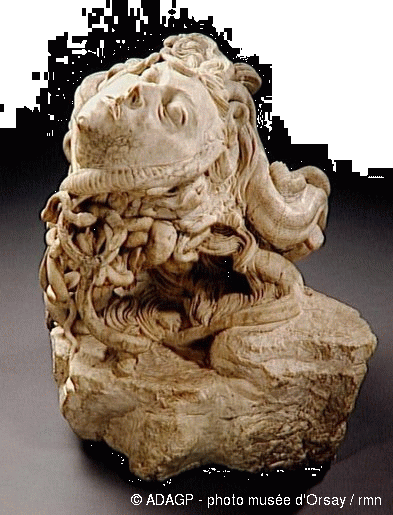
As expected, there were several Medusas, but Dardé's Eternal Sorrow (1913) was quite horrid and lovely.


Lévy-Dhurmer's Medusa / The Furious Wave has  snakes that have turned  into colorful seaweed (looking familiar and rather Atlantic in origin), lashing about in the water.


Because the show was ending with Surrealism, this was a really good set up for Hans Bellmer.  Charles Jeandel made these bondage cyanotypes in the 1890s, but they were "discovered" in the 1980s. 


There were many images of  DEATH and Femmes Fatales, like Gauguin's Madame La Mort and Jean Delville's Idol of Perversity.

But nothing really prepared me for this quite amazing Léon Frédéric (one of my favorite Symbolist / Naturalist Belgians). This is Vanity (1893). She has it all.  See through black blouse, red hair, skull AND hourglass and she is in a cemetery.


 So, I guess you know where my head was at when I saw this a few minutes later as I walked to the Trocadero.  I suppose that this could have been a fashion shoot on the top of a tourist bus, with the base of the Eiffel Tower in view, but they had a microphone and she was shaking her head around in a disturbing way.  Maybe there was a monster, or better yet, DEATH that was going to be CGI'd into the scene.