For several years my research has concerned the culture of death in
Brittany. I have long been interested in the reception of medieval
visual culture in the nineteenth and early twentieth centuries.
This is a video that I edited in 2012 for a session at the Babel Working Group in Boston.
This
project assembles bits of video that I have shot over the past three
years on short trips to France that address these overlapping concerns. Throughout the video, I
made layers that act as effects from natural phenomena—sparkles of
sunlight on a pond, moss on a huge boulder, a poppy waving in the wind,
boiling water reflected on the ceiling, a reflection on a stream, a slow
pan across a diamond-shaped window with snow outside. Nature dances
across stony things that don’t move.
Danse Macabre: a video work in progress from maura coughlin on Vimeo.
Here are my French sources:
La Martyr: one of the oldest enclos paroissiaux (parish
closes) in Finistère (11th-17th cent.): stone steps lead up to the top
of the 16th century triumphal gateway. Adam and Eve are on the
building’s façade as is a “mermaid” that might signify the pre-CR notion
in Brittany that hell is damp and cold.
Kermaria-an-Iskuit: a Breton church in Plouha (Côtes-d'Armor), (13th
century) that has one of the most well-preserved Danse Macabre wall
paintings with 47 figures (c. 1500) and a prominent 19th century skull
box.
The sculpted figure of Ankou (death) at the church of Ploumilliau, (Côtes-d'Armor), 17th century.
Painted Skull Boxes in the Cathedral of St. Pol-de-Léon, Finistère: 32 boxes 17th-19th centuries.
Ossuary (15th century) at the cemetery of Saint-Hilaire Marville,
(Lorraine) The Breton practice of preserving individual’s skulls in
marked boxes was taken up here, in Northern France in the 19th century.
Shot through the metal bars on the ossuary.
Joël Thépault, Placard Mortuaire (2006-7), a cupboard of skulls and
other things carved by hand into the rock face at “Les Lapidiales”: an
exhausted limestone quarry that has since 2000 has been an open air,
international artist residency program for young sculptors, Port
d'Envaux (Charente-Maritime). I found this first by chance by looking
for something entirely else.
Images from other places:
a mossy rock in Montague, MA, a sarong blowing in the wind, a poppy, a
garage door, a sparkling pond, a reflection on a stream and boiling
water in Wellfleet, Provincetown and Eastham MA.
Stone: Hard old granite from Brittany and the soft limestone of the Charente.
Sound sources:
a refrigerator in a 19th-century distillery in Cognac, samples
from Saint-Saens’ Danse Macabre, ambient sound in Kermaria including the
ancient tour guide, bells at La Martyre.
Showing posts with label skulls. Show all posts
Showing posts with label skulls. Show all posts
Monday, August 19, 2013

Wednesday, June 5, 2013
Back in France-- June 2013


Bouguereau's 1850 painting of Dante and Virgil witnessing a homoerotic wrestling match that ends in cannibalism is pretty dark. I wonder what the wealthy and influential neo-conservative promoters of his painting (and a lot of pretty awful academic naturalism) think about this?

There were a lot of Fuseli paintings (not so good up close). Mad Kate is rather funny:

This lovely Redon was quite enchanting with its cold and presumably mildewed Gothic interior and the lit up stained glass.

I saw two young guys with cute punk haircuts staring at this Friedrich:

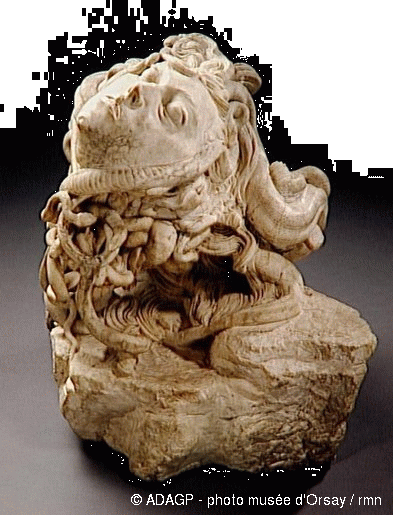
As expected, there were several Medusas, but Dardé's Eternal Sorrow (1913) was quite horrid and lovely.

Lévy-Dhurmer's Medusa / The Furious Wave has snakes that have turned into colorful seaweed (looking familiar and rather Atlantic in origin), lashing about in the water.

Because the show was ending with Surrealism, this was a really good set up for Hans Bellmer. Charles Jeandel made these bondage cyanotypes in the 1890s, but they were "discovered" in the 1980s.


There were many images of DEATH and Femmes Fatales, like Gauguin's Madame La Mort and Jean Delville's Idol of Perversity.


But nothing really prepared me for this quite amazing Léon Frédéric (one of my favorite Symbolist / Naturalist Belgians). This is Vanity (1893). She has it all. See through black blouse, red hair, skull AND hourglass and she is in a cemetery.


Subscribe to:
Posts (Atom)