Showing posts with label peasants. Show all posts

Wednesday, October 16, 2013

Indigo: Part 1

Indigo democratized blue.  My obsessions with indigo in textiles and the history of indigo in global trade have at last materialized into an argument of sorts, with an aim to look at blue clothing in French rural painting.

 "....indigo crossed class lines ... becoming the color of sailors and workers. With Napoleon it became the color of war. After the soldiers came the police pretty much the world over, and then, in one mighty crossover, indigo went from being the color of uniforms to becoming, in addition, the uniform of the anti- uniform "casual wear;' the jeans worn today by most of the people most of the time the world over, rich or poor."
   Michael Taussig "Redeeming Indigo"


Blue workers' smocks in paintings by Van Gogh (1888) and Cézanne (1896).

In these two paintings, the blue workers' smocks are crucial agents in making visual and material contrasts. Van Gogh lovingly paints the old peasant Patience Escalier, a man of the earth of Provence, his hands every bit as worn from sun and work as his wrinkled face. The blue of his smock vibrates against  the orange background, burning hot with the southern sun.  Cézanne paints a worker's blue blouse up against an 18th century screen-- an aristocratic, exclusive blue tapestry.  In this collage of blues is a pastoral fantasy of nature right behind a man whose presence speaks of the truly physical nature of work outside.


Peasant Smock dyed blue with indigo.


Before the late-nineteenth century invention of analine dyes, indigo was the best and truest blue. Production of indigo (formerly an expensive import from India) took off in French colonies in the 18th century, making this deep blue widely accessible. Although the term "blue collar" to denote manual labor seems to have arisen only in the 1920s,  the long association of blue with work has held -- from the French bleu de travail to American denim-- indigo was the blue of labor.


Georges Seurat, Little Peasant in Blue, 1882


Léon Fréderic, The Chalk Sellers, 1882–1883, detail


Norman Shepherd's Smock, 1950s,
 Linen and Cotton (source: ebay)


Manet, Café Corner, 1878, Bleu de Travail jacket, France, 1940s.

In the realist vocabulary which underwrites many of Cézanne and Van Gogh's images of rural life, blue materializes peasant form. Jean-François Millet's Sower, a revolutionary image of the French peasant, powerfully enfranchised in the wake of the 1848 revolution (which gave all male citizens the vote) strides across a plowed field, casting his seed widely. The indigo of his trousers and the red of his smock allegorize the French nation in the form of its rural people. 


Millet, The Sower, 1850, Boston mfa

Millet's friend and biographer Alfred Sensier described it thus: "a young fellow of a wild aspect, dressed in a red shirt and blue breeches, his legs wrapped in wisps of straw, and his hat torn by the weather. "


Millet, Grafting a Tree, 1855

Images of the land-owning farmer also depicted peasant clothing in primary colors, especially red and blue.  Critic Pierre Petroz noted of Peasant Grafting a Tree: "His pants are of a dull blue; although his knees have made a mark in them, there are few creases, as the fabric is thick and coarse. He wears wooden clogs. His stance, with one foot forward, gives his body stability, and permits his arms freedom of movement."

Son pantalon est d’un bleu terne; quoique la place des genoux y soit marquée, il fait peu de plis, comme toutes les étouffes épaisses et grossières; il est chaussé de sabots. Une jambe portée en avant donne au corps une assiette plus sûre, qui permet aux bras une plus complète liberté de mouvement.  


 Peasant costume is serviceable, coarse and lumpy as Petroz notes. The woman in Millet's painting, who holds the infant and watches the graft being made wears a long blue skirt, visible below the bulky blanket or shawl that wraps her middle.

 Millet did not dress peasants as if they were Grecian goddesses as did his academic naturalist peers and followers. As an amateur ethnographer of the rural present, he collected common items of peasant costume,  as Julia Cartwright described: "in one corner of the room lay a whole heap of blouses and aprons of every shade of blue — some of the deepest indigo, others bleached almost white from constant exposure to sun and air. Here, too, were handkerchiefs for the head — marmottes as they were called in Millet’s old home — cloaks and skirts of faded hues, more beautiful in his eyes than the richest stuffs."


Millet, Study for Woman Baking Bread, c. 1853


Millet's drawings, often preferred today to his finished paintings, show intense observation and attention to the material and character of clothing: the fall of an apron, for instance,  in this sketch for the painting Woman Baking Bread.


It was material detail that engaged with the real. Clothing spoke volumes:  a carefully mended, sun-faded blue dress, the hang of hard-worn pants —clothing that was as common and used up by rural labor as the bodies that had made it so.
Woman Baking Bread


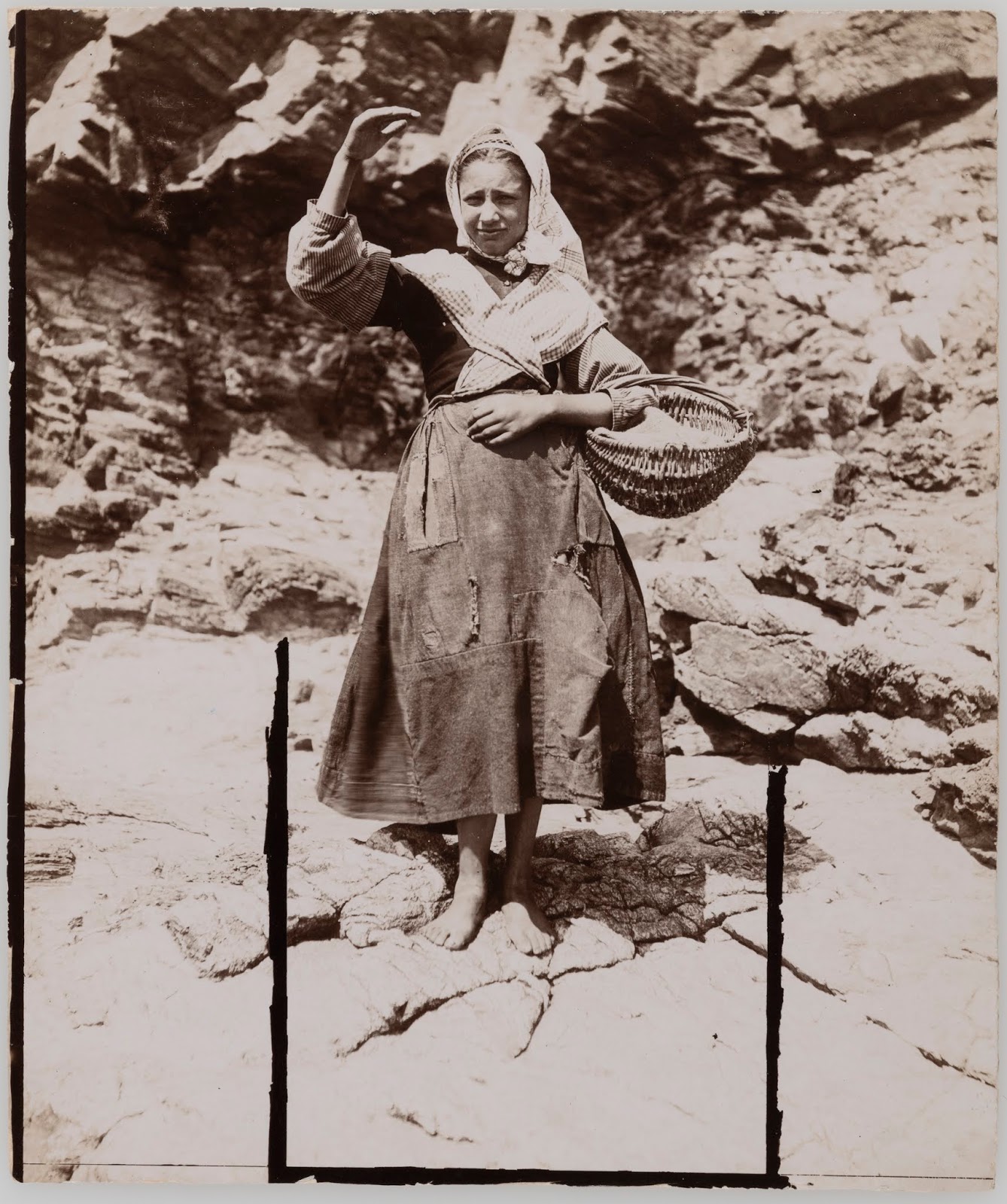
The photography of the Geniaux brothers in Brittany c. 1900 likewise was interested in describing mended & repaired work clothing because of the ways it spoke of authentic labor.


Millet had a taste for the aesthetic of the worn and mended.   Peasant mending of busted work clothing- from necessity alone- finds recent emulation in faux- tattered designer denim that pretend to Japanese Sashiko stitching.


Millet, The Gleaners, detail.


The Goncourts Brothers remarked in 1862 upon the way that Millet integrated peasant clothing to their forms and labor:

[i]t is prodigious the way Millet has caught the outline of the peasant woman, the woman of hard work and weariness, leaning over the ground and picking up clods of earth! He has made a rounded design, making the body into a bundle, with none of the provocative lines of the flesh of a woman; a body which poverty and toil have flattened out as if with a roller; a body which seems when it moves to be toil and weariness in motion; no hips, no breasts, a worker in a sheath, the color of which seems to come from the two elements in which she lives, brown of the earth, blue of the sky.


Millet, Man with a Spade, 1855-58.


Pissarro, Shepherd and Women Washing Clothes at Montfoucault, 1881


Pissarro, Peasants in the Fields, Eragny, 1890, detail
Gustave Geffroy, an early supporter of Impressionism who was versed in scientific theories of color in 1892 described the art of Camille Pissarro as having taken the "closest look at the peasant since Millet" yet that created "a totally different conception of the peasant from Millet, an intimate sense of rural life, a clarified vision of local truths, of the uniqueness of its charms, of the color of clothing worn there. It is a fine roughness, a calm malice.

In the work of this artist, enamored by bright light, by the extreme heat of the afternoon (that past criticism treated as the violent work of a madman) comes the delicate sensibility of one who knows and expresses-- in a language of nuances-- the charm of rustic life."


...le regard le plus attentif fixé sur les paysans depuis Millet, et une conception toute differente de celle de Millet, un sens intime de la vie rurale, une vision nette de la vérité locale, de la particularité des allures, de la couleur des vêtements. C’est d’une fine rudesse, d’une malice tranquille. Chez l’artiste épris des vives lumières, des fortes chaleurs des après-midi, et que la critique d’hier a parfois traité en violent et en énergumène, il y a un délicat qui sait et qui exprime en un langage de nuances, le charme de la vie rustique.


Sensitivity to the wearing of blue clothing tells this story.

As in the image of Patience Escalier, Vincent Van Gogh painted peasant workers in blue. He wrote extensively of his specific color choices, often mapping out his paintings in letters to fellow artists.

                                                                                
 Vincent van Gogh, letter to Émile Bernard, Arles, 19 June 1888, Letter 7, page 1


"Large field with clods of plowed earth, mostly downright violet.

"Field of ripe wheat in a yellow ocher tone with a little crimson.

"The chrome yellow 1 sky almost as bright as the sun itself, which is chrome yellow 1 with a little white, while the rest of the sky is chrome yellow 1 and 2 mixed, very yellow, then.

"The sower's smock is blue, and his trousers white. Square no. 25 canvas. There are many repetitions of yellow in the earth, neutral tones, resulting from the mixing of violet with yellow, but I could hardly give a damn about the veracity of the color. Better to make naive almanac pictures—old country almanacs, where hail, snow, rain, fine weather are represented in an utterly primitive way. The way Anquetin got his Harvest so well.

Van Gogh, Peasant Plowing with Peasant Woman, 1884
Van Gogh, Peasant Binding Sheaves, 1889


Years earlier, in 1885, he had mused on his understanding of the "naturalness" of this color in peasant clothing:

I am ... looking for blue all the time. Here the peasant's figures are as a rule blue. That blue in the ripe corn or against the withered leaves of a beech hedge - so that the faded shades of darker and lighter blue are emphasized and made to speak by contrast with the golden tones of reddish-brown - is very beautiful and has struck me here from the very first. The people here instinctively wear the most beautiful blue that I have ever seen.

It is coarse linen which they weave themselves, warp black, woof blue, the result of which is a black and blue striped pattern. When this fades and becomes somewhat discoloured by wind and weather, it is an infinitely quiet, delicate tone that particularly brings out the flesh colours.

Well, blue enough to react to all colours in which hidden orange elements are to be found, and discoloured enough not to jar.


Just like the blue/orange pallette of Patience Escalier, Van Gogh, when copying from Millet's prints of seasonal labors in the asylum at St.-Rémi (1889-90), re-painted his working peasants in blue.


Millet/ Van Gogh, Noonday Rest.

This blue/orange contrast of opposite pits the coolness of indigo against the sun burnt thatch of plants that were once green. A cooked and dried agriculture. The working body is coloristically the landscape's other.


film stills from Hugo.


Incidentally, Martin Scorcese's recent film Hugo uses just this color contrast (as a smart friend mentioned to me). Blue nostalgia.


More on indigo.


Tuesday, August 6, 2013

filthy peasants


This is an expansion and revision of a talk, "Rot to Cash Crop: Waste, Thrift and Recuperation in Nineteenth-Century Visual Culture" that I presented at "The Green Nineteenth  Century" in Milwaukee, WI (2009). Some of this material goes back to my dissertation (2001, NYU).


To him who has nothing it is forbidden not to relish filth.

                                                                                    Samuel Beckett, “Molloy” 1955


...one of the most radical of the moral distinctions between human beings and most of the lower animals; that of which the absence, more than of anything else, renders men bestial; [is] the quality of cleanliness. Can anything be more entirely artificial? Children, and the lower classes of most countries, seem to be actually fond of dirt: the vast majority of the human race are indifferent to it: whole nations of otherwise civilized and cultivated human beings tolerate it in some of its worst forms, and only a very small minority are consistently offended by it. Indeed the universal law of the subject appears to be, that uncleanliness offends only those to whom it is unfamiliar, so that those who have lived in so artificial a state as to be unused to it in any form, are the sole persons whom it disgusts in all forms. Of all virtues this is the most evidently not instinctive, but a triumph over instinct. Assuredly neither cleanliness nor the love of cleanliness is natural to man, but only the capacity of acquiring a love of cleanliness.
John Stuart Mill,   On Nature 1874


Discussions of dirt, following the insights of Anthropologist Mary Douglas, position it as a relative value, a conceptual moving target.  Yet dirt itself is the literal base of rural culture.  Representations of dirtiness in 19th century visual culture, literature and criticism articulate relationships of class, place and value: relationships posited between the viewer and the rural worker; the bodies and living spaces of rural people and animals;  the place of an image's exhibition and the place it depicts; the value of an image as object and the value (or lack thereof) of accumulated waste. But the visual ordering of base matter as waste, filth or dirt is not simple or absolute. This post positions images amid snippets of travel narratives and other texts to examine how all of these representations work in the ongoing processes of making and interpreting signs of place, class, sexuality and identity.
Pioneer Woman with a wheelbarrow of Dried  Buffalo Dung.

Pay to Pass: A woman pays a street sweeper to cross a gangplank over a dirty street (color litho)
From a series of types on the streets of Paris, c. 1820s after Horace Vernet.

Dirt may at times be matter out of place, filth may be tidied and transformed, waste may be recuperated.  Even processes of decay and corruption may be framed as purifying. Visual representations of human and animal closeness and the associated filth of contact not only participate in its ordering, sorting and transformation: they also mark out potential values for the accumulation or re-cycling of this material.  As they do so, they position identities for the bodies that make contact with this material as well as for the viewer who watches.  As the comparison of these first two images suggests, one’s relationship to bodily waste, whether human or animal very clearly suggests positions of class and place—as the lady pays to avoid the turd in the city street, the pioneer woman picks up buffalo chips-- one would presume by hand—far off on the peripheral frontier. Mary Douglas, writing in Purity and Danger (1966) argues that dealing with the dirty can be threatening, for it entails negotiating that which is ambiguous or anomalous.  Douglas’s ideas have been built upon for decades in cultural studies to suggest that filth or dirtiness as a material and conceptual state can be understood as an problem of slippage from stable categorization and contradiction. She notes that pre-capitalist societies resolved these contradictions through purification rituals.

According to Julia Kristeva’s psychoanalytic study of abjection (1982), bodily waste and other forms of defilement are “what life withstands” … for  “dung signifies the other side of the border—the place where I am not" (3). Within modern capitalist culture,  ritual is no longer invoked to successfully resolve this problem of waste, for now contradictory notions of use value and exchange value are bound up in this system. Kristeva shows us that as we work to constitute ourselves as individuals, we try to extricate or distance ourselves from that which we term waste.  Yet as literary critic Anne McClintock remarks, building upon Douglas and Kristeva, the abject inhabits “ the cusp of domesticity and market, industry and empire” and it “returns to haunt modernity as its constitutive, inner repudiation: the rejected from which one does not part”( Imperial Leather, 72).


 Olivier Perrin, one of the first illustrators to represent rural Breton life, includes a pair of pigs feeding from a bucket that sits beside the cradle of a sleeping child. The shape of the bucket is echoed by the covered three-legged cooking pot that sits beside the wooden bench, that itself is before the open box bed (the pot placed there looks suspiciously like a chamber-pot). This one-room cottage is thus a very mixed space of work (the mother spins), sleep (for the child and father who dozes by the fire) cooking and the feeding of animals.

For many nineteenth travel writers, identifying their encounters with rural life as dirty or filthy was a way of both defining and imaginatively crossing culturally constructed boundaries of gender, class and location. Sociologist Alain Corbin notes that early travelers in the French countryside, ill-prepared by reading the idylls of pastoral poetry, were often shocked by the filthy life of the peasants they encountered. In many rural households, farm animals and people lived side by side in winter—the heat of the stable warming the domestic space: “the stench of dung coupled with the odors of laundry and washing-up, the exhalations of putrid and fermented scents from stable and dairy located too close by were the basic elements of the picture” (156). These typical elements of the Breton cottage interior (frequently re-presented today in many museums of rural life in Brittany) were repeated throughout the nineteenth and early twentieth centuries in prints, paintings and photographs.
Olivier Perrin, The Cradle, illustration from Galerie Bretonne ou vie des Bretons de l’Armorique c. 1808.

Charles Géniaux, Common room of a peasant house in Morbihan, Brittany, open to the stable, early 20th century (MuCEM)


Others notes that  “with bare feet, [having] cleaned out their animals, or been out with a muck-cart... [they] do not hesitate, just as they are, to go to bed or to put back on their clothes (Vigarello, 197). In line with Douglas, in travellers' modern notions of hygiene, there was no space for farm animals in the house. The early 20th century photograph of a peasant house in Brittany by Charles Géniaux, a photographer of everyday life in Brittany, who was based in Rennes, includes the hallmarks of the Breton cottage interior: the dish rack on the left with its Quimper faience, and the closed doors of the wooden box-bed on the right.
a typical Breton box-bed


Between these pieces of carved, wooden, built-in furniture sits a boy in wooden clogs and work pants who turns away from the camera and toward the heads of three cows who are eating from the rough wooden trough before them. The animal space of the barn and the human spaces of the home are wed together, again,  to suggest that the peasant family draws no boundaries between domestic space of eating and sleeping and animal dirt and odor.


Giovanni Segantini, Two Mothers, 1889.
Galleria d’Arte Moderna Milan.

Alpine Symbolist painter Giovanni Segantini, in The Two Mothers pairs a women with a sleeping child aside a cow and calf.  Both offspring have presumably just nursed: the woman sits on a milking stool, although there are no signs of her milk pail. The milk is both there, and already consumed. For Kristeva, the maternal body is made particularly taboo and powerful, with its permeable boundaries of self and other, its abject fluids and familiarity with waste. Her writings on abjection posit it as an experience that establishes boundaries -- such as those between self and other or human and animal.  Human breast milk is a particularly abject fluid in modern culture because it is on  a border between two distinct entities or territories. A boundary between nature and culture, between the human and the non-human” (75).  Segantini's scene seems constructed solely to spell out the  closeness of peasant and animal maternal instinct. For this rural woman, the act of nursing an infant in the stable, rural female animality is naturalized: her working body is conflated with her bovine double (Nochlin, 133). Fingers that press to her the sleeping child echo the dangling teats of the cow who has recently calved. By the rosy glow of the lantern, Segantini invites us to to imagine the warm smells of cow, hay and sleeping baby. Like the Perrin drawing and the Géniaux photograph, the image conflates human domesticity and domesticated animals.


Gauguin, Woman in the Hay with Pigs: In the Full Heat of the Day, 1888.


An overt erotic charge is often produced by the closeness of peasant women to farm animals. In a painting from his time in the South of France, Gauguin depicts  a rural female worker, wearing her cap but nude to the waist. Beside her, kicked by her clog is the hind end of a pig, whose presence heightens the perception of her own animal sexuality (Silverman 230).  In the foreground is another yellow/orange form: is this more hay or another animal rump? This thing, the pig, the clog are illogical fragments that just barely make sense.  Her sunburnt, pink claw of a hand is outstretched—emphasizing the exposure of her skin to the sun—and now to the scratchy rawness of hay.  Her bare breasts are pressed to the hay bale that is strangely blue (in the shade?)  or is it a boulder or something else peeled back (like laundry), furled out or unfolded like the clothes at her waist? Images of noonday rest had often implied a sexual encounter, but this single, partially undressed woman seems to be having an imagined sensual experience with the materials of the landscape (and the pigs are only getting in the way).

Gauguin painted this in Arles, where all workers tried to escape the noonday sun of summer--but it could hardly have been from observation as this image imagines a quite uncomfortably tactile or haptic encounter with various and ambiguous sorts of materiality.  As William Cohen, writes in  FILTH,   "by the time one has encountered and repudiated filth, it is too late—the subject is already besmirched by it.  In this way, filth challenges the very dichotomy between subject and object. It does so according to  a psychoanalytical logic, whereby repulsion and attraction unconsciously converge, and phenomenologically as well: the filth of the object defiles the subject who, identifying it as such, has had to rub up against it.” The longer I look at Gauguin's puzzling painting, the stranger I feel: sunburnt, itchy and irritated.


The peasant images of Symbolists Gauguin and Segantini built upon an earlier nineteenth century tradition of the peasant's relationship to dirt and farm animals in realist imagery.  The "authentic" rustic reputations of painters John Constable and Jean Francois Millet depended upon their intimate and material knowledge of the rural landscape and its labors, including the digging and spreading of animal manure.
A Muck Spreader, c. 1830.  Popular British Print.


Constable’s View of Dedham of 1814-5 (Boston), features a great dung-heap before an expansive view of the artist’s native Suffolk landscape. The remarkable anecdote that always accompanies this painting recounts its commission as a wedding gift to a young lady as a “symbol of good husbandry.” The image of the dung spreader was a common rustic type of laborer but Constable locates his workers on the other side of the pile from us—further back than in initial studies for this painting-- this filthy labor is thus naturalized as a seasonal task performed in the cyclical time of the rural landscape. Michael Rosenthal writes on the inclusion of manure as a marker of the work's modernity: “Constable’s iconography was resolutely contemporary, and the last thing you would associate with Claude would be a dunghill...manure [was] essential for heavier crops, indicated that these farmers knew their business.” (1983, 86). Rosenthal also notes that several English poets of the late 18th and early 19th centuries wrote odes to muck heaps, and that the Georgic mode of praising the intelligent management of the land could accommodate this ‘low’ subject.
Jean-François Millet, Peasant Spreading Manure, 1855. Raleigh, N.C.
Jean-François Millet repeated the image of the dung-spreader in prints, drawings and paintings. In the painting Peasant Spreading Manure, a man forks out heavy, soiled mats of animal bedding, to create a landscape of animal droppings.  As a seasonal task, spring "manuring" meant that the fields would be fertile for another summer.

Some of Millet's supportive critics praised the poetic ability of his painting painting to transcend the filthy: one reviewer wryly comments that ever since the fables of la Fontaine “there had been none but Millet who could find pearls in manure.”(A. de Belloy Salon de 1868). Yet other critics complained that the widespread representation of rural life in Salon painting of the 1860s had brought on an invasion of village life that dragged in with it “its wooden clogs and manure.” (Alexis de Calonne, “Salon de 1861” La Revue Contemporaine).


The reception of Millet's realism, like that of Courbet, had been bound up in dirt. Nadar’s 1852 caricature of the painter at work resembles either a human profile or a very strange, hilly landscape. On further inspection, perhaps both: a portrait of animated land, quickened to human likeness in the tradition of popular 16th-century Netherlandish anthropomorphic landscapes-- but most likely a parody of the Sower of 1850, whose hatted figure, striding downhill under wheeling birds, has been radically simplified and combined such that the figure and land (indeed the figure and ground) are one.
Millet, The Sower, 1850, Boston MFA.


The caricatured image echoes both Théophile Gautier’s comment that The Sower seems to be ‘painted with the very earth he is sowing,’ and Michelet’s earlier description of the French peasant --as a "man of the earth"--who lives completely in it --who seems formed in its image. In Nadar’s version, The Sower is a remade by the caricatured Millet in a portrait that transcends likeness, preferring primordial matter.  Because its painter uses earth-working tools rather than the usual implements of painting, the signifier and the signified are brought ever closer: binding up its dirty literalness in a tight semiotic bundle.  The caricature neatly encapsulates the material confluence of paint, dirt, painter and peasant body in the mid-19th-century critical reception of Realism.  It is important to clarify that, in this body of discourse, dirt is spoken of as soil or ‘la terre’ when it is the literal earth worked by the peasant; yet dirt is also ‘matter out of place,’ in the terms laid out by Douglas when the body of the peasant and its degree of dirtiness is at stake.  Although a semantic disjunction between French (terre/sale) and English (dirt/dirty) would seem to complicate the equation, the terms ‘sale’ and ‘terreux’ frequently collide in 19th-century description of Realist paint surfaces, particularly those describing lower class bodies.  Although dirt was the base and basis of rural reality, critics found painting that brought too much of it to the surface blurred the boundaries between medium and message.
 Man with a Wheelbarrow, also known as Peasant Returning from the Manure Heap 1848-52  (Indianapolis Museum of Art).

Millet's many images of peasants moving muck from barn to heap to field, depict a network of human, animal and earth, all generally subsumed under the category of "nature."

Michael Thompson's Rubbish Theory of 1979 discusses economic systems under which waste objects come to be revalued. Whereas most commodities are conceived of as either transient or durable, many things can move between categories—thus waste may be recuperated as valuable matter. Yet Thompson argues that the very concept of value is predicated on – and needs-- the idea of rubbish.  Extending this discussion, Cohen remarks that “anything designated filthy cannot be reused, at least until it is renamed or reconceived as waste or trash, which can be recycled. The potential for this reimagining means that the regenerative fantasy hovers at the edge of the filth that excludes it. In this way too, filth seems at once to occupy one side of the subject / object divide and to undo the opposition itself."

In Zola's Earth, recycling or compost mania grips Zola’s “modern farmer” Hourdequin, who, he tells us has experiment with the fertile potential of a vast array of filth: from “road-sweepings” “wool-waste” to “odd shovelfuls of muck, dead animals, decomposing dog-droppings or filth drained from ponds,” he has run the gamut of waste. Yet, at the end of this exhaustive inventory, he declares, “there’s nothing like good farm muck. The trouble is there’s never enough of it. And then again people spoil it, they don’t know either how to prepare it or use it.” (392) Thus waste itself may be wasted when the chance is not taken to reclaim it. Zola’s “realist” novels certainly expressed many a bestial fantasy about the lives and “natural” drives of the peasant, yet these descriptions of peasant manure hoarding ring true with many environmental histories of farming that recount the scarcity of manure in Europe (that drove the global trade in guano).

The nineteenth century peasant “manure economy” was summed up by one German pastor who remarked that “The peasant will do everything to get a lot of manure.”  In his memoirs,  Breton farmer Jean-Marie Deguinet (1834-1904), himself an expert in converting wasteland to fertile fields (and reusing even dishwater in animal feed) likewise mentions that the worth of a farmer could be measured by his  manure pile.


Tuesday, July 16, 2013

To the Sea


  Looking for sites where artists worked in coastal Brittany, in June, 2013, I sought out this ancient communal lavoir (spring-fed washing spot) in Ploumarc'h, the site of an ancient village that has become a favorite park, high along the coastline in Douarnenez.

I was shooting images of the site, the washing pool, and the view back to the town.  Flipping the switch on my camera to video, I shot a few seconds of water gurgling through the lavoir, en route to the beach below.


I have become increasingly interested in thinking about ecological relationships in Brittany, and the ways in which visual and material culture interact as part of these "assemblages"(in Jane Bennett's terms) that complicate any simple thinking about nature and culture, or that blur the lines between notions of figure and ground,  tourist and peasant, labor and leisure and city and country-- categories that have long held sway in the discussion of landscape representation.

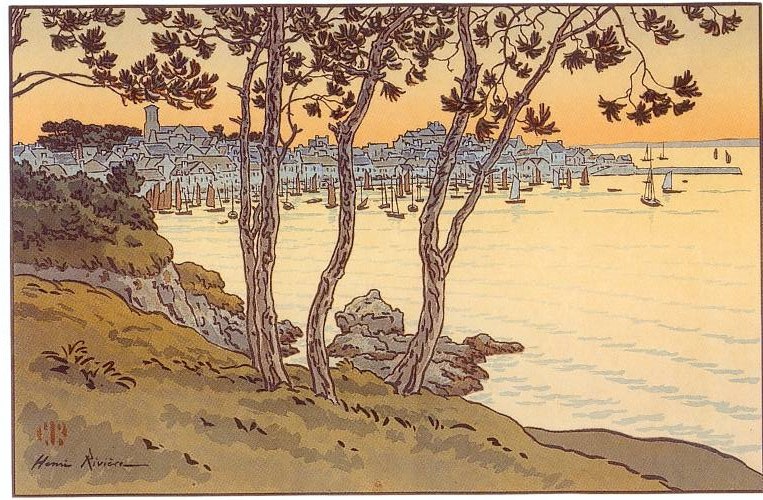
In the later 19th century, at the same time that the fisheries of Douarnenez were booming, so many artists were drawn to the port town of Douarnenez in Brittany  that it came to be called the “Breton Barbizon.” The view from the heights of Ploumarc'h, looking back toward the town, was a favorite theme of many artist.  I am very fond of Henri Rivière's japoniste prints of the 1890s such as this view.
Henri Rivière, The Port of Douarnenez, lithograph, 1893

Artists came to this spot for the view and for the assemblage of everyday life they might encounter:  ships on the bay, the fishing port, young girls herding sheep on its heights, laundresses working, women carrying water from the spring, women and girls watching for the return of the fishing fleet. As is true of most works produced in artists colonies, we seldom have the least inkling that any tourists, artists or other outsiders are present in the landscape.
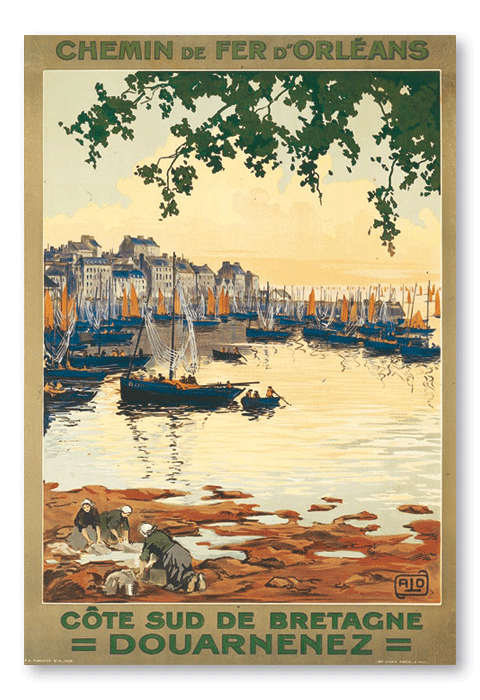
Charles Hallo, Travel poster, c. 1922

Photographs posed for postcards -- only slightly more documentary -- give us some idea of the dirt, the grime, the deprivations of everyday life. Echoing these views, travel narratives from the late 19th century describe the beautiful artistic themes to be found in Douarnenez yet bemoan the pervasive stink, dirty children, untidy homes, fish everywhere.


Tourism is, of course, an experience that involves more than the visual: I am interested in re-imagining bodily experiences of the senses in the visual culture of this area. Some images and narratives offer tourists' complaints about dirt and smell in their encounters with Douarnenez.


   “It is a busy, dirty, and not very attractive town, with one principal street leading down to the port; but walk out of it in any direction, so as to escape the odours of the sardine factories, and the views from the high ground are most rewarding.”
                                                                                Henry Blackburn 1880


Dirt was part of everyday life-- but so was the effort to keep it at bay. The lavoir in Ploumarc'h is marked by a historical plaque that, in French, Breton and English tells the visitor about the day-long washing that women would perform here, with "the dirty working clothes from husband and sons coming back from the sea." This was dirty laundry of a degree almost unfathomable to modern domestic standards-- and it took a day's soaking, scrubbing and wringing to work it out of the clothing.  As many of the women at the lavoir most likely also worked at the sardine canneries in Douarnenez, there was also a great deal of fish filth to be washed out of their own garments.


 In 1865, naturalist painter Jules Breton first visited the Brittany coast and was immediately drawn to its landscape and peasant culture.  What he avoided in his paintings he certainly mentioned in his autobiography:  on his arrival “Douarnenez, whose women and whose beach I had heard so highly extolled, impressed me but little at first”  ….  “But how different everything looked the next day when, after winding our way through a network of fetid  streets permeated with a nauseating odor of sardines,  we suddenly found ourselves in sight of the bay that stretched before us in its dazzling beauty !”


After finding the beaches, he later waxed eloquent in his autobiography about the “exotic” racial differences that he came to appreciate in the women of Douarnenez  “one brings to the mind the dolmens of Celtic  forests, the other the harems of the East.”

Breton,  Spring on the Seashore 1867


Jules Breton, Washerwomen of the Brittany Coast, 1870


 Breton returned many summers to Douarnenez, where one of his favorite themes was that of women washing clothing in a spring by the sea. A young sardine processor, Jeanne Calvet, posed for many of the female figures in Spring on the Seashore (1867) and The Washerwomen of the Breton Coast, (1870). Especially in the 1870 painting, Breton clearly turned his back to the busy fishing town to produce these very successful Salon paintings. This is not unlike the laundresses that Gustave Courbet painted in 1865, working at a spring at low tide in Etretat.


On the beach at at Ploumarc’h was a washing spot where fresh water ran from a stream to meet the sea.  On the cliff above this was the more formal lavoir. Breton may have studied women crouching at the rectangular pool -- scrubbing, wringing and hauling bundles of laundry-- clothing undoubtedly saturated with the indelible stink of fish-- but he posed them at a second washing spot, down on the beach. These women are bleached of the dirt, oil, and odors of their everyday labors, yet this loss of identity or specificity is nothing out of the ordinary when one takes money to pose for an artist.


The artist preferred the exoticism of these strapping yet improbably immaculate barefoot women laundering equally improbably clean – and relatively few garments in this almost natural site. His resulting image of everyday labor has no trace of Douarnenez’s pervasive presence of dead fish, waste, packaged food or, for that matter, global trade, as a sardine worker is transformed into a timeless goddess, enacting a plein air ritual washing of white linen. We have no sense of the grime that women like Jeanne Calvet were trying to remove from their clothes—the oily, sickening smells that clothes take on when one works with fish (and that flow from them in the communal waters).
Breton, undated drawing of a fisherman's wife, Douarnenez.


Post card photographers (who also loved the captive spectacle of women at work -- sometimes bottom up washing clothes outside), likewise, seem to have frequently cruised both spots at Plomarc'h to shoot women at work.


With my represented experience of water gurgling through this site, I’d like to bring back some materiality to Breton’s images, to re-entangle them a bit in Douarnenez.

I work on landscape and place and deeply believe in site visits as research.  This is not to do an art history that tries to  pass judgment on the accuracy of the images, or to argue for recuperating a more socially engaged reading of this academic painter, because I’d like to think about what these paintings DO in this network of the life of a port, not just how they erase or mirror “reality.”

And what can video do?

Water moves through this site; as you watch it and hear it you might perhaps imagine touching its coolness or smelling the mossy banks, or losing a foot's grip on a slippery rock. The water moves through this site, and the water that did move through it brought the laundresses whose dirt moved out and through it, and the painters and photographers came, and watched the laundresses, and they made their images that moved outward into the world, and these images in turn brought later visitors, like me, to this place, to be assembled in contemplation of its materiality.