Showing posts with label beach. Show all posts

Tuesday, August 13, 2013

Dead Fish Landscape


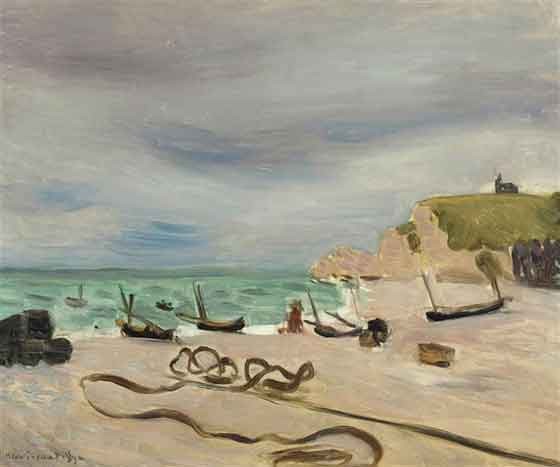
I can't get over seeing this Matisse painting last winter in New York.  I mentioned it a few posts ago while writing about seaweed.  This is Matisse on the Normandy coast in 1920. I had always associated this period of his career with the Riviera-- especially those beautiful, escapist interiors in Nice, filled with flappers playing odalisque in front of his fantastic collection of textiles, chinoiserie and Moroccan screens ( I was in Nice for a few days when I was traveling by train at age 19, with my slightly punk haircut and my backpack, feeling a bit nefarious in such a glamorous place). But this is Etretat: a Normandy beach almost synonymous with Monet, who repeatedly returned to paint these famous pierced cliffs, especially in the 1880s (this is explored at length in the Met's catalog). 

Monet was not the first-- Courbet was there in the 1860s, joined by his American pal Whistler and his gorgeous Irish girlfriend Joanna Hiffernan.  Matisse had Monet's color and Courbet's sensuality in mind when he painted a series of images of dead fish on the rocky strand.

<p> Please enable flash to view this media. <a href="http://get.adobe.com/flashplayer/">Download the flash player.</a></p>

Please enable flash to view this media. Download the flash player.


Looking closely at the image, it's really odd: there is an assemblage of fish and shellfish on a bed of seaweed: a green langoustine and an eel are the easiest to spot. Like most of Monet's later paintings, Matisse's fish painting eschews the messy human uses of the beach, presenting only a fish still life, leaved up out of the water onto a neat mat of seaweed. Part landscape, part still-life, this is an image of the intertidal zone-- where flint rocks, fallen from the limestone cliffs, form the beach, and where the sea rises and falls, leaving seaweed and other deposits on the beach with one tide, and whisking them back with another.


    As Robert Herbert's excellent book on Monet showed, this beach, so often painted as an empty, sublime expanse, was right in front of a busy boardwalk that was up against a town packed with hotels, casinos, summer villas, restaurants and shops. 

Summer tourists, fishermen, boats, laundresses washing tourists' clothing and hotel linens all vied for space on the beach. At this point, as John Gillis points out, the boardwalk divided the people who worked on the beach (and their boats, seaweed, fish, etc) from those who were at the beach. 
But, in this painting, Matisse's beach is covered in fish. The human life is absent.

Thinking about the oddity of dead fish as "actors" in a landscape, or as features of a landscape, I remembered a very strange Dutch painting that I had seen in New Orleans over a year ago. 
This is a collaborative painting (one of many of this type), by Willem Ormea (-1673) and Abraham Willaerts (1577-1664).  Ormea, a still-life painter, did the fish and Willaerts, a marine painter, the landscape.  The Dutch were quite proud of their maritime prowess, as well as their mastery of nature in reclaiming so much of their watery landscape for agriculture. Ormea and Willaerts produced many dead fish landscapes-- a quick search found the examples below.  These paintings all seem to bring together a spectacular harvest of the sea with the industriousness of a worked coastline. Many of the fish poses and types repeat: the contorted bodies, the open mouths, the shiny rigor mortis.  They seem impossibly large, beached and blotting out the beach. Close up and huge they dwarf the human activity in the middle ground and distance.


 Of course, there are many examples of fish in still life paintings: Chardin comes to mind in particular, and the many great market paintings of the northern painters like Snyders and Aertsen.
Chardin
Frans Snyders, Fish Market, 1618
Van Valckenborch, Fish Market, early 17the century

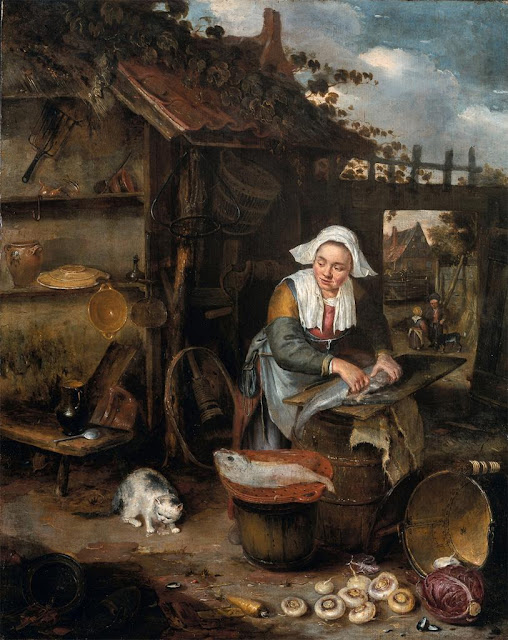
Hendrik Potuyl,  Housewife in an inner Courtyard Cleaning Fish, 1639-1649


In the 1860s and 70s, Bazille and Manet produced some of the most seductive images of fish, hearkening back to the Dutch masters: 


And Manet also made some lovely sketches of fishermen working on the coast at Boulogne-sur-mer.
 
Van Gogh painted several still lifes of fish and crabs. By chance, I saw both of the crab paintings within a few days of each other on a trip to both London and Amsterdam. 

Van Gogh, Two Crabs, 1889, National Gallery, London

Gauguin, in his Impressionist period, made an awkward  stab at a dead-fish in a landscape painting (pillaging a bit from Courbet, Manet and Cézanne all at once).


Paul Gauguin, Still Life with Jug and Red Mullet, c. 1876


But in spite of this artistic lineage and dialogue, this remains undeniably strange: I cannot but imagine the viscosity, the flies, the temporal presence of the slippery fish, the approaching tide and the brown seaweed.


Here are some more images from Matisse's 1920 stay in Etretat (he showed 31 paintings from his summer in Etretat in October of 1920, and they sold like hotcakes)

Tuesday, July 16, 2013

To the Sea


  Looking for sites where artists worked in coastal Brittany, in June, 2013, I sought out this ancient communal lavoir (spring-fed washing spot) in Ploumarc'h, the site of an ancient village that has become a favorite park, high along the coastline in Douarnenez.

I was shooting images of the site, the washing pool, and the view back to the town.  Flipping the switch on my camera to video, I shot a few seconds of water gurgling through the lavoir, en route to the beach below.


I have become increasingly interested in thinking about ecological relationships in Brittany, and the ways in which visual and material culture interact as part of these "assemblages"(in Jane Bennett's terms) that complicate any simple thinking about nature and culture, or that blur the lines between notions of figure and ground,  tourist and peasant, labor and leisure and city and country-- categories that have long held sway in the discussion of landscape representation.

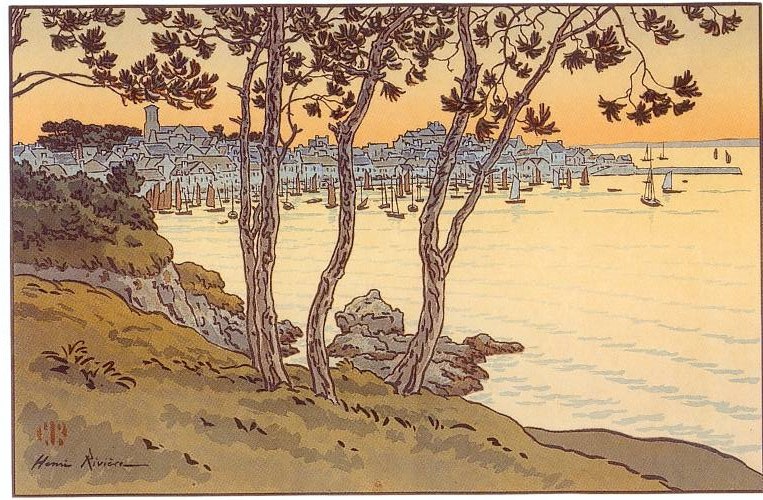
In the later 19th century, at the same time that the fisheries of Douarnenez were booming, so many artists were drawn to the port town of Douarnenez in Brittany  that it came to be called the “Breton Barbizon.” The view from the heights of Ploumarc'h, looking back toward the town, was a favorite theme of many artist.  I am very fond of Henri Rivière's japoniste prints of the 1890s such as this view.
Henri Rivière, The Port of Douarnenez, lithograph, 1893

Artists came to this spot for the view and for the assemblage of everyday life they might encounter:  ships on the bay, the fishing port, young girls herding sheep on its heights, laundresses working, women carrying water from the spring, women and girls watching for the return of the fishing fleet. As is true of most works produced in artists colonies, we seldom have the least inkling that any tourists, artists or other outsiders are present in the landscape.
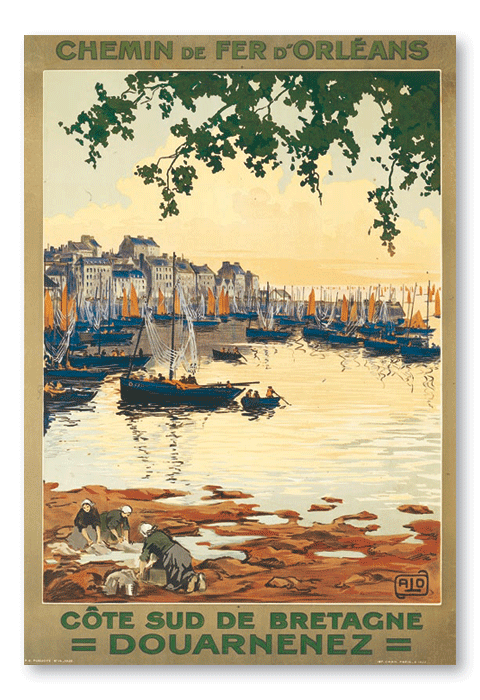
Charles Hallo, Travel poster, c. 1922

Photographs posed for postcards -- only slightly more documentary -- give us some idea of the dirt, the grime, the deprivations of everyday life. Echoing these views, travel narratives from the late 19th century describe the beautiful artistic themes to be found in Douarnenez yet bemoan the pervasive stink, dirty children, untidy homes, fish everywhere.


Tourism is, of course, an experience that involves more than the visual: I am interested in re-imagining bodily experiences of the senses in the visual culture of this area. Some images and narratives offer tourists' complaints about dirt and smell in their encounters with Douarnenez.


   “It is a busy, dirty, and not very attractive town, with one principal street leading down to the port; but walk out of it in any direction, so as to escape the odours of the sardine factories, and the views from the high ground are most rewarding.”
                                                                                Henry Blackburn 1880


Dirt was part of everyday life-- but so was the effort to keep it at bay. The lavoir in Ploumarc'h is marked by a historical plaque that, in French, Breton and English tells the visitor about the day-long washing that women would perform here, with "the dirty working clothes from husband and sons coming back from the sea." This was dirty laundry of a degree almost unfathomable to modern domestic standards-- and it took a day's soaking, scrubbing and wringing to work it out of the clothing.  As many of the women at the lavoir most likely also worked at the sardine canneries in Douarnenez, there was also a great deal of fish filth to be washed out of their own garments.


 In 1865, naturalist painter Jules Breton first visited the Brittany coast and was immediately drawn to its landscape and peasant culture.  What he avoided in his paintings he certainly mentioned in his autobiography:  on his arrival “Douarnenez, whose women and whose beach I had heard so highly extolled, impressed me but little at first”  ….  “But how different everything looked the next day when, after winding our way through a network of fetid  streets permeated with a nauseating odor of sardines,  we suddenly found ourselves in sight of the bay that stretched before us in its dazzling beauty !”


After finding the beaches, he later waxed eloquent in his autobiography about the “exotic” racial differences that he came to appreciate in the women of Douarnenez  “one brings to the mind the dolmens of Celtic  forests, the other the harems of the East.”

Breton,  Spring on the Seashore 1867


Jules Breton, Washerwomen of the Brittany Coast, 1870


 Breton returned many summers to Douarnenez, where one of his favorite themes was that of women washing clothing in a spring by the sea. A young sardine processor, Jeanne Calvet, posed for many of the female figures in Spring on the Seashore (1867) and The Washerwomen of the Breton Coast, (1870). Especially in the 1870 painting, Breton clearly turned his back to the busy fishing town to produce these very successful Salon paintings. This is not unlike the laundresses that Gustave Courbet painted in 1865, working at a spring at low tide in Etretat.


On the beach at at Ploumarc’h was a washing spot where fresh water ran from a stream to meet the sea.  On the cliff above this was the more formal lavoir. Breton may have studied women crouching at the rectangular pool -- scrubbing, wringing and hauling bundles of laundry-- clothing undoubtedly saturated with the indelible stink of fish-- but he posed them at a second washing spot, down on the beach. These women are bleached of the dirt, oil, and odors of their everyday labors, yet this loss of identity or specificity is nothing out of the ordinary when one takes money to pose for an artist.


The artist preferred the exoticism of these strapping yet improbably immaculate barefoot women laundering equally improbably clean – and relatively few garments in this almost natural site. His resulting image of everyday labor has no trace of Douarnenez’s pervasive presence of dead fish, waste, packaged food or, for that matter, global trade, as a sardine worker is transformed into a timeless goddess, enacting a plein air ritual washing of white linen. We have no sense of the grime that women like Jeanne Calvet were trying to remove from their clothes—the oily, sickening smells that clothes take on when one works with fish (and that flow from them in the communal waters).
Breton, undated drawing of a fisherman's wife, Douarnenez.


Post card photographers (who also loved the captive spectacle of women at work -- sometimes bottom up washing clothes outside), likewise, seem to have frequently cruised both spots at Plomarc'h to shoot women at work.


With my represented experience of water gurgling through this site, I’d like to bring back some materiality to Breton’s images, to re-entangle them a bit in Douarnenez.

I work on landscape and place and deeply believe in site visits as research.  This is not to do an art history that tries to  pass judgment on the accuracy of the images, or to argue for recuperating a more socially engaged reading of this academic painter, because I’d like to think about what these paintings DO in this network of the life of a port, not just how they erase or mirror “reality.”

And what can video do?

Water moves through this site; as you watch it and hear it you might perhaps imagine touching its coolness or smelling the mossy banks, or losing a foot's grip on a slippery rock. The water moves through this site, and the water that did move through it brought the laundresses whose dirt moved out and through it, and the painters and photographers came, and watched the laundresses, and they made their images that moved outward into the world, and these images in turn brought later visitors, like me, to this place, to be assembled in contemplation of its materiality.