Showing posts with label france. Show all posts

Wednesday, February 5, 2014

Douaumont

  The photo of a former village in Northern France is framed with texts above and below it, something like you see here. Toby Everett and I took this a few days before Christmas in 2013. It was the second time we had been there, and had been talking for quite some time about what kind of image would be adequate to represent the history of this landscape.


Douaumont has Gallo-Roman origins and was called “divine name” (divus noms) in Latin; at 380 meters in altitude, the village sat on the highest land of the region. Two hundred and eighty-eight people lived here in 1914. On their land grew potatoes, linen, hemp and fruit trees. Horses, chickens, cows, dogs and pigs were part of everyday life in the streets, homes and yards. In February of 1916, as the Battle of Verdun began, Douaumont was erased. Today it remains a destroyed village, a permanent reminder of the cost of war.


Vibrant grass and mature trees grow over a rolling aggregate of brick, cement, limestone, bones, barnyard, household items, and artillery shells. Yet aggregate is too mild a term to describe this violently haphazard assemblage, this polluted, exploded land whose permanently mixed (yet never thoroughly fused) materials had once made up a place and a community. We saw this unidentifiable mixture laid bare where the grass had been pulled away by a souvenir hunter with an illicit metal detector or a wild boar rooting in the soil.


These are photos of Douaumont and its one main street, before and after the war. 


Friday, December 27, 2013

Art Things: at the new Louvre in Lens


The new satellite Louvre in Lens France (a town notorious for the unrivaled height of its coal slag heaps) is a remarkable case of a museum design in a dialogue with its site. This and other photos come from my visit in December, 2013, about a year after it opened. Lens is a small city in the Nord-Pas de Calais region of northern France, a half-hour's drive from the vibrant city of Lille, and near the Belgian border. It is a place that has been repeatedly destroyed-- by coal mining, both World Wars, Nazi occupation, large-scale mining diasters, and post-industrial unemployment. Ever since the Guggenheim built its satellite museum in Bilbao, art museums have been inaugurated in depressed areas (depopulated city centers, former factory sites, etc.) to foster economic development. Lens certainly meets this criteria, and adds to it a landscape in ecological ruin.

The mining site that the new museum occupies was a working site until 1960. There was coal mining in the area until 1986.


Early 20th century post card showing Pit #9 in Lens

The Slag Heaps of Lens in the 1930s
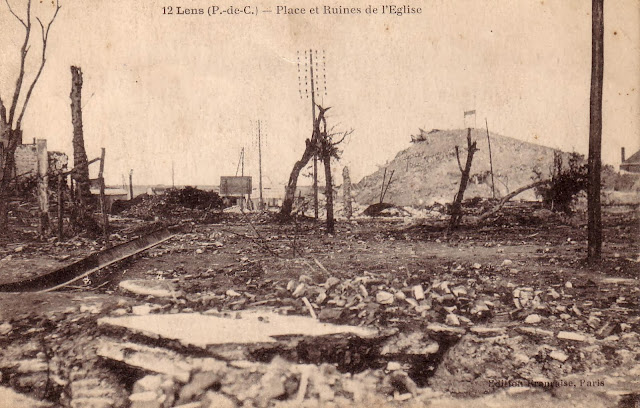
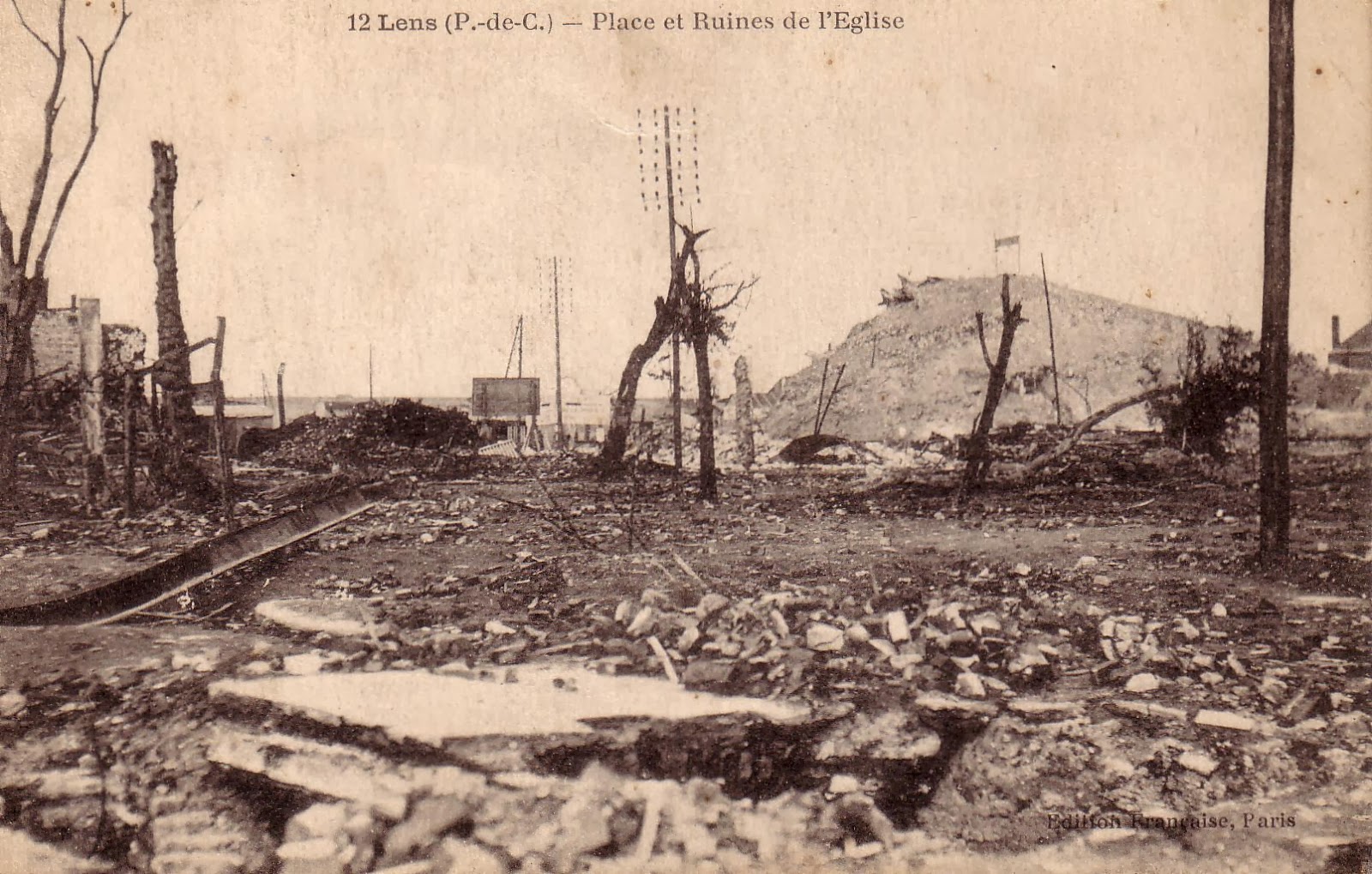
Situated on the front, Lens was blown apart by the First World War.  Like much lost in Northern France, old memories survive because of photographs and post cards. The nineteenth-century invention of photography served to commemorate its modern devastation.
Lens Before and After the First World War
Ruins of a church in Lens
German Pillbox near Lens. Canadian troops inspect a captured German gun position near Lens, France in September 1917.

I had read about the open-plan of the great hall in the museum, and was intrigued by the imposed constrains of the silver walls (more on this below) but I was unprepared for the affective qualities of the museum's landscape design. 


The concrete seems only a fragile and partial covering (something here for now) on this site. Like new skin slowly covering a healing wound, the flat areas of the concrete have gaps that seem to reference deep craters in this landscape that cannot simply be filled in and forgotten.  But today the dirt mounds up where it can, exploding with verdant life.


In this region, it rains a lot in the winter,  deepening the color of the dark soil and the emerald life coming from it. Water seemed to be almost weeping up from the saturated soil on the morning we arrived. As the fog cleared and the sun came out, the water retreated.


In this photo below, from 2012, it appears that the gaps had been planted last year.  There was something much more vulnerable about seeing the dirt exposed.


December 2012, just before the museum opened you can see the careful plantings that filled the openings in the concrete. This is not one of my photographs-- it is a promotional image from that time.

 The site had become overgrown after being closed in 1960. These trees (below), sprouting from the former mine shaft, seem to have grown since then. They attest to the vitality of the land, as do many of the tree-covered slag heaps we passed in the region, their winter skeletons revealing the perfectly cone-shaped hills beneath them.  This ruined land was once fertile (like most of the contested front) and it is green despite it all. My previous work on quarries, wasted space, entropy and land art came to mind immediately. This was a work of land art, an "ecovention" that reused and reframed a previous ecological mess.


The former entrance to the mine shaft is marked and preserved here, making clear what has been filled in.

Post card showing debris filling the mine shaft after the War.

The round shapes break into straight lines in the concrete.


In the "Galerie du Temps," chronology rules the order of things: a timeline of five millenia etched on one aluminum wall orients the viewer as she chooses a path through the 32,000-square-foot space.  Twenty percent of the collection moves in or out each year-- thus a return visit in five years guarantees a completely refreshed collection.


The works are well labeled and there are the audio guides for those who want them.
http://www.louvre.fr/en/oeuvre-notices/composite-female-statuette
Each work is an island, a thing that must be negotiated.  Without rooms to divide by nationality, medium, period or style, each work is moved around. Sculpture, usually placed as a thing to be negotiated in a room full of paintings or metalworks, often marooned in dusty cases, occupy the same museum space as paintings, affixed to freestanding uprights.

 Paintings are things too.... they have three dimensionality, weight and texture.
All art objects are things. All need support, protection. In this open room, dialogues are infinite, pathways are not proscribed.
 The layout makes us look through, look back, look across the collection in startling ways.  

Chronology is the organizing tool, yet the viewer's movement rarely follows a strict historical march.


We end in the mid 19th- century, as in the Louvre-Paris. This wonderful Barye bronze seems more animated than ever before in such a vibrant space.


This is a reflective space (sorry about the pun but bear with me). The reflective aluminum walls that cannot have work hung upon them direct the focus inward inside, to almost vanish outside.  Outside, the aluminum walls almost vanish in the landscape, and the glass walls encourage repeated reflection on the site.


Links:   DE ZEEN  review


Detail review


 Interview:


And an unrelated story about a Chinese  hotel being built in a quarry [!]

Tuesday, August 13, 2013

Dead Fish Landscape


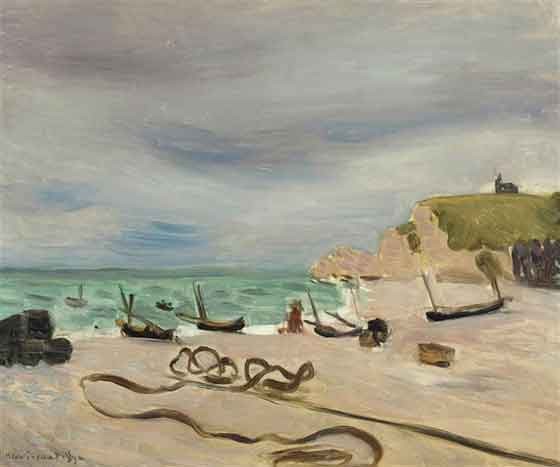
I can't get over seeing this Matisse painting last winter in New York.  I mentioned it a few posts ago while writing about seaweed.  This is Matisse on the Normandy coast in 1920. I had always associated this period of his career with the Riviera-- especially those beautiful, escapist interiors in Nice, filled with flappers playing odalisque in front of his fantastic collection of textiles, chinoiserie and Moroccan screens ( I was in Nice for a few days when I was traveling by train at age 19, with my slightly punk haircut and my backpack, feeling a bit nefarious in such a glamorous place). But this is Etretat: a Normandy beach almost synonymous with Monet, who repeatedly returned to paint these famous pierced cliffs, especially in the 1880s (this is explored at length in the Met's catalog). 

Monet was not the first-- Courbet was there in the 1860s, joined by his American pal Whistler and his gorgeous Irish girlfriend Joanna Hiffernan.  Matisse had Monet's color and Courbet's sensuality in mind when he painted a series of images of dead fish on the rocky strand.

<p> Please enable flash to view this media. <a href="http://get.adobe.com/flashplayer/">Download the flash player.</a></p>

Please enable flash to view this media. Download the flash player.


Looking closely at the image, it's really odd: there is an assemblage of fish and shellfish on a bed of seaweed: a green langoustine and an eel are the easiest to spot. Like most of Monet's later paintings, Matisse's fish painting eschews the messy human uses of the beach, presenting only a fish still life, leaved up out of the water onto a neat mat of seaweed. Part landscape, part still-life, this is an image of the intertidal zone-- where flint rocks, fallen from the limestone cliffs, form the beach, and where the sea rises and falls, leaving seaweed and other deposits on the beach with one tide, and whisking them back with another.


    As Robert Herbert's excellent book on Monet showed, this beach, so often painted as an empty, sublime expanse, was right in front of a busy boardwalk that was up against a town packed with hotels, casinos, summer villas, restaurants and shops. 

Summer tourists, fishermen, boats, laundresses washing tourists' clothing and hotel linens all vied for space on the beach. At this point, as John Gillis points out, the boardwalk divided the people who worked on the beach (and their boats, seaweed, fish, etc) from those who were at the beach. 
But, in this painting, Matisse's beach is covered in fish. The human life is absent.

Thinking about the oddity of dead fish as "actors" in a landscape, or as features of a landscape, I remembered a very strange Dutch painting that I had seen in New Orleans over a year ago. 
This is a collaborative painting (one of many of this type), by Willem Ormea (-1673) and Abraham Willaerts (1577-1664).  Ormea, a still-life painter, did the fish and Willaerts, a marine painter, the landscape.  The Dutch were quite proud of their maritime prowess, as well as their mastery of nature in reclaiming so much of their watery landscape for agriculture. Ormea and Willaerts produced many dead fish landscapes-- a quick search found the examples below.  These paintings all seem to bring together a spectacular harvest of the sea with the industriousness of a worked coastline. Many of the fish poses and types repeat: the contorted bodies, the open mouths, the shiny rigor mortis.  They seem impossibly large, beached and blotting out the beach. Close up and huge they dwarf the human activity in the middle ground and distance.


 Of course, there are many examples of fish in still life paintings: Chardin comes to mind in particular, and the many great market paintings of the northern painters like Snyders and Aertsen.
Chardin
Frans Snyders, Fish Market, 1618
Van Valckenborch, Fish Market, early 17the century

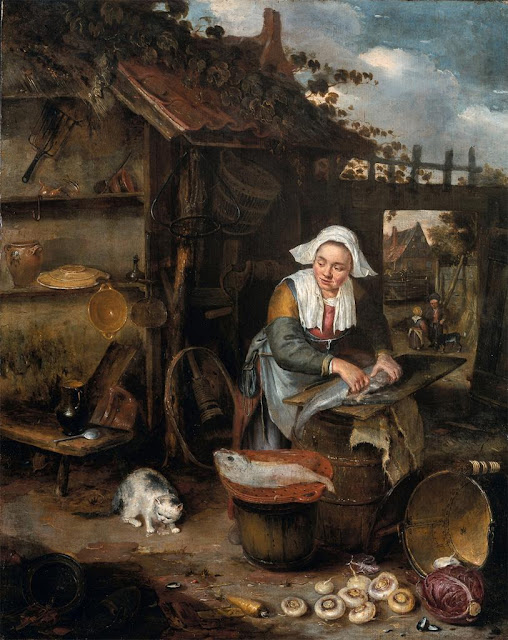
Hendrik Potuyl,  Housewife in an inner Courtyard Cleaning Fish, 1639-1649


In the 1860s and 70s, Bazille and Manet produced some of the most seductive images of fish, hearkening back to the Dutch masters: 


And Manet also made some lovely sketches of fishermen working on the coast at Boulogne-sur-mer.
 
Van Gogh painted several still lifes of fish and crabs. By chance, I saw both of the crab paintings within a few days of each other on a trip to both London and Amsterdam. 

Van Gogh, Two Crabs, 1889, National Gallery, London

Gauguin, in his Impressionist period, made an awkward  stab at a dead-fish in a landscape painting (pillaging a bit from Courbet, Manet and Cézanne all at once).


Paul Gauguin, Still Life with Jug and Red Mullet, c. 1876


But in spite of this artistic lineage and dialogue, this remains undeniably strange: I cannot but imagine the viscosity, the flies, the temporal presence of the slippery fish, the approaching tide and the brown seaweed.


Here are some more images from Matisse's 1920 stay in Etretat (he showed 31 paintings from his summer in Etretat in October of 1920, and they sold like hotcakes)