Showing posts with label ecology. Show all posts

Friday, March 20, 2020

Cecile Borne: Tideline Gleaner (part one)


Cécile Borne finds her subject matter and materials on the tide line. She is a multi media artist based in Douarnenez, Brittany. Like the gleaner who was so often painted or photographed picking the remains of a wreck, gathering mussels, kelp or flint stones on the French North Atlantic shores, she finds her materials on the intertidal zone. But unlike seaweed that has been gathered from these beaches for centuries, this fabric is unmoored, never having had a holdfast—an alien resident of the water, not bound to a zone, but subject to the tides and wind. She calls her self a plasticienne chiffonnière: a rag sculptor.

Douarnenez is a port town of many contrasts, from its past as both an industrial fish cannery and an artist colony, to its present as a town of artists and summer visitors in the aftermath of fishing. In installations of the past several years, materials gathered on the strand assume new forms. As part of her practice, she walks the Bay of Douarnenez, searching out unlikely material: textiles that the sea has thrown back on the land. This stretch of coastline was the site of her adolescence—it is a place intimately known. When collecting in the summer, she often swims or dances on the strand. This is a fully embodied practice-- hardly a coincidence as Bourne studied contemporary dance in London and Paris. Her practices of walking, salvaging, recuperation and installation are all bound together in an ecological immersion in place.

Inlets or criques along this bay each have their own particular beach—one made of round stones, the next sand and slate fragments, another flat strand. Many small streams course down through villages, farmland and woodland to the sand, mixing fresh with sea water. Favorite criques are those that best trap old cloth. Some textile bits were old-fashioned sardine boat sails that have been in the sea for years, others are fragmentary, waxed garments formerly worn by fishermen or sailors. Occasionally she finds pieces of household linens or even costumes discarded after Mardi Gras. Other textiles are hard to identify: some were used as rags on boats and then discarded. Some are just lost or slip overboard. The sand often buries things that come ashore; when they spend time under it, they are marked by its minerals and organic matter.  These imprinted fragments are later found only by attentiveness to the smallest visible edges. Although the Bay of Douarnenez opens to the Iroise, the North Atlantic and, of course, to the global ocean, most of the textiles that wash up have local origins (such as rags that bear the mark of a hospital laundry service in nearby Vannes).

walking the bay


Mixed seaweed and debris on the wrack line

So much human generated debris is snared, reeled in or caught in the rocks and tide pools, or buried in the sand above the tide—scattered in pebbles, entangled in dried kelp. Few people notice the amount of textile waste on the beach. Often it has taken on the color of sand and, like plastic, it breaks down into ever smaller parts.

Material gleaned from one walk
There are fabrics she does not take such as socks, sneaker innersoles, or the remains of an entire container of hotel slippers that went into the bay and, for a time, washed up across the bay. Until recently, she was uninterested in the ubiquitous plastic that, unlike organic textiles, cannot quickly return to matter; it only gets smaller and more imbedded in the seaweed, more fragmentary in the tide pools.


Dentelles, or sea-lace

Borne collects, rinses, and orders her marine fabrics. Her studio serves as an archive, storehouse or sorting zone for her recuperated, and potentially restored finds. This is not exactly a process of recycling—rather it is a form of forensic restitution that permits the material to tell stories of the bodies that once wore it.


a fragment of waxed clothing

A black piece of fabric, when held up to the light, has ripples etched into it: she says that the sea often leaves marks of its movement. She tells me stories she has gleaned from her finds: over the course of a few winters of walking the bay, she gradually reassembled a 12-piece set of damask table napkins. All had the same pattern in the weave, yet were marked very differently by the sea, who acted on them, while submerged, like a master printmaker. She had not found any others at all like this: they must have come from the same source. She speculates that this singular set-- perhaps no longer new-- might have been passed down in the family of a fisherman who used them as rags on his boat and, one by one, they were thrown or fell into the sea, and made their way to shore all along the bay. A shirt with a pattern of sailboats was torn in half, used for some dirty job, then discarded. The two pieces washed up in utterly different sites, and, as unlikely as it might be, Borne found them and made them almost whole. A garment with no value in the world becomes an uncanny found object; its two halves utterly marked by their separation and remaking in the sea.
reunited pieces of a long-separated shirt, printed with sail boat pattern.

Her forensic research opens up untold narratives: finding the name of a child in a raincoat revealed an entire family history: triangulating the coat size (8 years), she determined that it had been in the sea for about 4 years. In reconstructing its story, she was led back, almost impossibly, to a psychoanalyst who had been one of her patrons. In another exceptional find, a stained Tyvek suit (likely discarded after Mardi Gras in Douarnenez) bore the name “LATEUSE.” When googled, its former owner was revealed to be a boastful local man who liked fast cars. Borne took apart the suit, stretching pieces that bore the imprint of his buttocks, knees and elbows. They became uncanny prints, a sort of Veronica veil or true icon of his body.

"Mu(e)s" installed in Saint-Merry, 2014. 
Another singular fragment is a red butcher's work-coat, that had been saturated at some point, in blue marine paint. Transformed through this unlikely process, and almost impossible to recreate, it became part of an installation "Mu(e)s" in Paris at the church of Saint-Merry in 2014.

"Mu(e)s" installed in Saint-Merry, 2014.

Suspended in mid air, the sea-marked textiles, now clean and stiffened, float as if votive offerings from the sea, relics of past lives, animated in an unfamiliar setting. Many Breton chapels are filled with votive offerings that give thanks for salvation and with cenotaphs that commemorate and mourn the lost at sea.

Interview de Cécile Borne from www.saintmerry.org on Vimeo.

In her exhibition "Vestiaires, cirés-récits" at the Port Musée in Douarnenez in 2015, Borne made found maritime clothing come to life, to speak as a second skin. The cracked surface of the ruined waxed garments were first marked by wear, then by what the sea, the sand and the sun did to them.


There is a powerful sense of mourning and absence in the installation: many of the brown, waxed garments are no longer common. Were they discarded by their owners, or do they speak of drowning?   Yellow fishing gear has aged or been stained olive or black. Some pieces, wracked up on rocks, or dug down into sand, became the substrate for algae and crustaceons. As organic matter grew, a once functional garment became abstracted by the agency of the sea.

Her installation of 2016, Disparition, is an homage to migrants lost at sea that took loss and mourning to a much wider scale. The presence of bodies, drowned in desperate attempts to find shelter and safety in Europe, are evoked in casts of torsos that float above collections of archived textiles. Mourning these victims of war and the cruelty of closed borders, the Breton culture of maritime votive objects assumes meaning for the global oceans.

Disparition

Here the sea definitively becomes a site of mourning. The installation laments the lost at sea, and, by extension, the emptying of the sea of all its vibrant life.


Portrait of Cécile Borne by Nedjma Berder

Wednesday, May 21, 2014

Maerl Sand

Among the permanent collection at the Morlaix Musée des Jacobins is a painting whose ecological realism has gone unremarked, as far as I can tell. This is Sand Boats (c. 1900-02), by André Dauchez.
After researching this painting and its connection to marine ecology, I am posting this short essay that uses this painting as a springboard for further thinking about the representation of ecological relationships on the Brittany coast.

Dauchez was a painter, illustrator, printmaker and passionate sailor who, from 1890 onward, spent summers in Brittany at his family's summer home in Bénodet. 
Dauchez, Boat on the Odet
Critics included him in a group of artists  that were dubbed the Bande Noire because they seemed to share a  rejection of impressionism's bright color in preference for more somber tones that they brought to their realist subject matter. This group included Charles Cottet, Lucien Simon, René Ménard, Edmond Aman-Jean, Ignacio Zuloaga, and Jacques Emile Blanche.  


Dauchez, Benodet, etching, c. 1900.
Like his friends Cottet and Simon, Dauchez was drawn to the topography and human life of the shore as seen in his many images of estuaries, river banks, ports and coasts.  He is best known for his etchings, although his linear, graphic sensibility translates well to his paintings.


 Sand Boats has the dark, sepia tonality of his prints.

André Dauchez, Sand Boats, c. 1900-1902. Musée des Jacobins, Morlaix.

 I was initially drawn to his image of the wrack line as it traces the last high tide; calligraphic coffee-brown seaweed is flattened to the tan sand, writing the rim of the intertidal strand. The sea is cold blue-gray, the sky a menacing violet. This is not the sparkling beach of a summer vacation that inspires pastel hues, rather this is a worked zone of the land, exposed by the dropping sea. The Bande Noire artists may have shunned the exaggerated color of Impressionism, but they did not avoid engaging with modernity. Their stylistic and thematic roots were in the gritty realism of Millet and Courbet from the 1850s and 60s.  And like the rural Impressionist themes of Camille Pissaro or Claude Monet along the Seine river in the 1870s,  Dauchez represented a form of modern, local labor -- on the Brittany coast. 


Wooden boats, retired from sardine fishing, have been refitted for the hauling of sand. Beached for the moment, they are being loaded one shovel-full at a time and will float, despite their groaning loads,  as the tide comes in.  Dauchez, the avid sailor, in his day-trips around the coast, would have seen sand boats working on the beaches of Loctudy, the Isle Tudy and Glénan islands (an archipelago off the south coast of Finistère).  This painting was featured in a recent winter exhibition of Post-Impressionism in the museum, and the catalog notes that the site is probably the beach of Trévignon in Tregunc (just east of Concarneau).


But I had to ask, why move sand by water, shoveled by hand? Why this sand?

 A bit of hunting for "bateaux de sable" turned up the information that maërl or coral sand was a natural resource, harvested on certain parts of the Brittany coast, and transported on boats known as sabliersPierre Primot, a former sablier, tells of the peasant-sailors from Gouesnach (just north of Bénodet, upstream on the Odet river)  known in Breton as "gab-mao"; they bought old sardine boats in Douarnenez or Concarneau to haul sand upstream to farmers who either purchased it on the docks in Quimper, or had the sand dumped on a nearby river-bank for their collection. At first the maërl sands were gathered by farmers who took to the waters.  This later became a trade in itself, as the demand for this sand expanded from agricultural applications to use in building materials and later water filtration.  Dauchez shows us these workers of the strand and river -- farmers of sea /sailors of sand, in their red and blue jackets, as they fill their boats, the sails rolled up into the boom, waiting for the tide and later the wind to take this heavy load upstream.


http://www.bretagne-racines.ac-rennes.fr/p290695Y/sablier.htm

On the North Coast of Brittany, the same exploitation of maërl sands moved up the Lannion and Morlaix rivers from surrounding estuaries.


As a modern agricultural practice introduced mid-century, maërl sand was added to reduce soil acidity (similar to the use of lime) and to impart magnesium, iron and other trace minerals. This is a scarce resource today that has led to dragging the ocean floor for maerl, to augment the fertility of the land (other uses of maerl include the making of concrete). In this unsustainable practice, nutrients move across the coastline, somewhat like the action of a swollen river spilling onto its floodplain, but a bit more like the displacement of matter effected by quarrying.


Maërl is a Breton name given to coralline red algae (or calcified algae), which grows in Northern European, shallow (and cool) sublittoral waters at the slow rate of about 1mm per year.  Unlike kelp and other rockweeds, maërl does not need to attach to a hard surface, and so can grow across mud, sand or loose pebbly bottoms.  In addition to the Brittany coast, this red and rock-hard seaweed grows in the coastal, wave-exposed waters of Ireland, Scotland and Cornwall. The red color of the growing plant bleaches to white when its dead and chalky skeletal remains wash up as sediment, mixed with the silica as sand. 


Coralline algae store large amounts of carbon in their cell walls in the form of calcium carbonate. This is the same material that formed the chalk cliffs of Normandy in the Cretaceous period, as calcium carbonate-rich sediment from coccolithophores, skeletal remains of the planktonic algae,  gradually accumulated on the bottom of the shallow warm seas that covered much of Northern Europe. 

In maërl beds, living algae grow atop layers of dead maerl, forming an environment  (like a coral reef) that is inhabited by many other forms of sea life.


An essay on the Nature and importance of Maerl Beds" posted on the UK Special Marine Areas Conservation website notes that living maerl beds are "a unique assemblage of biotopes."  


A "biotope" is "[t]he habitat (i.e. the environment’s physical and chemical characteristics) together with its recurring associated community of species, operating together at a particular scale... The habitat encompasses the substratum and the particular conditions of wave exposure and other factors which contribute to the overall nature of the location. The term community refers to a similar association of species which regularly recurs in widely separated geographical locations."
This is a wonderfully rich term, that is more vibrantly inclusive (of all interdependent life within a specific zone) than the concept of a habitat (a backdrop or residence of a living thing).  Living maerl is  topos, biological place, and powerful metaphor.

The biodiversity of shallow water maërl biotopes is explored extensively in the lavish, full-page illustrations of Etude de la Mer (1913), a deluxe marine biology text magnificently illustrated by Breton artist, Mathurin Méheut. The fleshy mauve of corralline algae repeats through many of Méheut's illustrations of sea life, set "sur un fond d'Algues Calcaires."  As Méheut shows us repeatedly, living coralline algae is the essential substrate of its complex biotope. This is noted in the
in the Encyclopedia of Tidepools and Rocky Shores:

"Many organisms have evolved to live in or on calcified algae as an alternative hard substratum.   For instance, certain species of bryozoans, hydroids, fleshy seaweeds, and calcified crusts grow directly on articulated coralline fronds in tidepools. Amphipods and polychaetes wrap themselves in calcified articulated fronds, and worms burrow into calcified crusts. Abalone, sea stars, limpets, chitons, and reef corals often recruit to coralline algae. Reef corals, in particular, chemically detect, metamorphose, and settle on or near coralline algae, which presumably indicate favorable coral habitat.  Similarly, many corallines grow as epiphytes on sea grasses and other algae and on the shells of snails, mussels, and barnacles. Occasionally the thickness of coralline accumulations
far exceeds that of the shell of the organism on which it is growing."   (Steneck and Martone
, 2007)


Describing Meheut's images of sea life, Gustave Babin waxed florid in 1913:

Ici, des lits de roches noires comme des houilles, bleues comme des ardoises, striées de bandes plus claires ou plus sombres, que viennent revêtir, encroûter comme d'une moisissure rose pâle, mamelonnée, des algues calcaires; et, sur ce champ, cette trame de beau tapis, s'épanouissent des gorgones, d'un incarnat de corail, des actinies rouge capucine, blanches avec des coeurs de chrome, telles des pâquerettes, vertes autour d'un bouton de velours brun, et faisant songer aux monstrueux échinocactus des terres chaudes, rayonnent des oursins jaune d'or, vert mousse, pourpre sombre, ponctués de flamme et d'or, rivalisant d'éclat avec les chrysanthèmes de nos automnes, des étoiles de mer défiant la splendeur des laques, des cadmiums, des cobalts les plus riches, tandis que de modestes moules, vêtues d'épiscopal violet ou de bleu de roi, cristallisent leurs colonies en décoratives rosaces. Plus loin, voici des prairies verdoyantes de zostères, longues et frêles lanières qui sont les gramens de la mer, tout étoilées par les spirographes de corolles jaunes: on dirait quelque pâtis terrestre, jonché de pissenlits, au printemps; mais ces fleurs épanouies sont vivantes, étranges animaux qui, à la moindre alerte, rentreront leurs tentacules d'ocre, qu'on prendrait pour les pétales tubuliformes de quelque bizarre reine-marguerite, et refermeront leur petit couvercle de nacre. ( L'Illustration, No. 3695, 1913).


Dauchez and Meheut do not give us the romantic notion of a Brittany that is one solid mass of rugged granite. Their images of the shore are specific to the place and, in Dauchez's case, to the practices of the human communities that inhabit it.  The living color of Meheut's maerl is gone from Dauchez's pale sand, but both artists present us with a realist vision of the shore's biotopes.


Links:


http://patrimoine.region-bretagne.fr/sdx/sribzh/main.xsp?execute=show_document&id=PALISSYIM22004048


http://arbannour.free.fr/histoire/les_chemins_de_sable.htm


http://www.sand-atlas.com/en/page/16/


Alain Bourbigot, marinier sur l'Odet de 1925 à 1963

 http://www.bretagne-racines.ac-rennes.fr/p290695Y/sablier.htm


Pêcheurs de sables by jfp

Friday, December 27, 2013

Art Things: at the new Louvre in Lens


The new satellite Louvre in Lens France (a town notorious for the unrivaled height of its coal slag heaps) is a remarkable case of a museum design in a dialogue with its site. This and other photos come from my visit in December, 2013, about a year after it opened. Lens is a small city in the Nord-Pas de Calais region of northern France, a half-hour's drive from the vibrant city of Lille, and near the Belgian border. It is a place that has been repeatedly destroyed-- by coal mining, both World Wars, Nazi occupation, large-scale mining diasters, and post-industrial unemployment. Ever since the Guggenheim built its satellite museum in Bilbao, art museums have been inaugurated in depressed areas (depopulated city centers, former factory sites, etc.) to foster economic development. Lens certainly meets this criteria, and adds to it a landscape in ecological ruin.

The mining site that the new museum occupies was a working site until 1960. There was coal mining in the area until 1986.


Early 20th century post card showing Pit #9 in Lens

The Slag Heaps of Lens in the 1930s
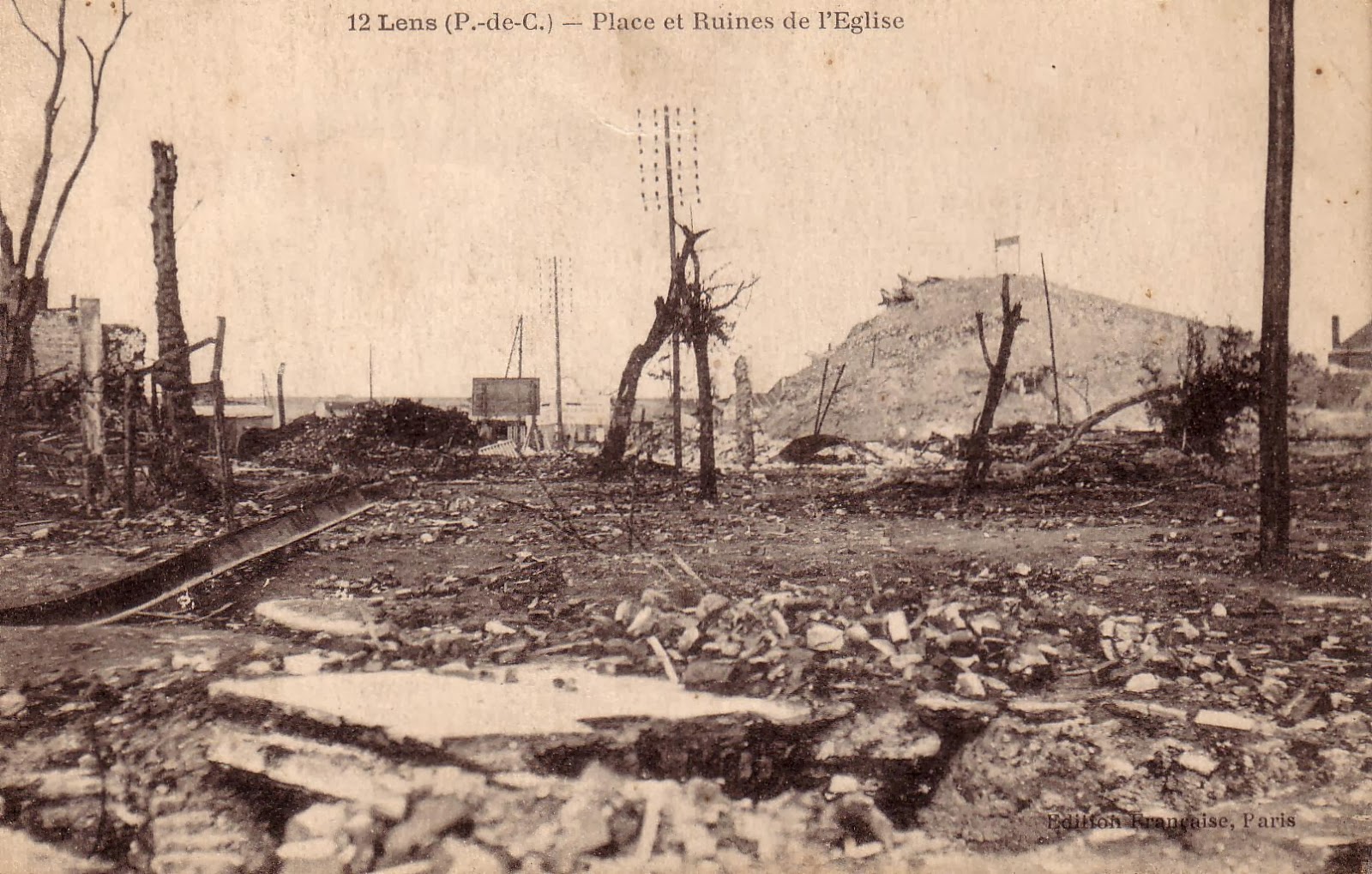
Situated on the front, Lens was blown apart by the First World War.  Like much lost in Northern France, old memories survive because of photographs and post cards. The nineteenth-century invention of photography served to commemorate its modern devastation.
Lens Before and After the First World War
Ruins of a church in Lens
German Pillbox near Lens. Canadian troops inspect a captured German gun position near Lens, France in September 1917.

I had read about the open-plan of the great hall in the museum, and was intrigued by the imposed constrains of the silver walls (more on this below) but I was unprepared for the affective qualities of the museum's landscape design. 


The concrete seems only a fragile and partial covering (something here for now) on this site. Like new skin slowly covering a healing wound, the flat areas of the concrete have gaps that seem to reference deep craters in this landscape that cannot simply be filled in and forgotten.  But today the dirt mounds up where it can, exploding with verdant life.


In this region, it rains a lot in the winter,  deepening the color of the dark soil and the emerald life coming from it. Water seemed to be almost weeping up from the saturated soil on the morning we arrived. As the fog cleared and the sun came out, the water retreated.


In this photo below, from 2012, it appears that the gaps had been planted last year.  There was something much more vulnerable about seeing the dirt exposed.


December 2012, just before the museum opened you can see the careful plantings that filled the openings in the concrete. This is not one of my photographs-- it is a promotional image from that time.

 The site had become overgrown after being closed in 1960. These trees (below), sprouting from the former mine shaft, seem to have grown since then. They attest to the vitality of the land, as do many of the tree-covered slag heaps we passed in the region, their winter skeletons revealing the perfectly cone-shaped hills beneath them.  This ruined land was once fertile (like most of the contested front) and it is green despite it all. My previous work on quarries, wasted space, entropy and land art came to mind immediately. This was a work of land art, an "ecovention" that reused and reframed a previous ecological mess.


The former entrance to the mine shaft is marked and preserved here, making clear what has been filled in.

Post card showing debris filling the mine shaft after the War.

The round shapes break into straight lines in the concrete.


In the "Galerie du Temps," chronology rules the order of things: a timeline of five millenia etched on one aluminum wall orients the viewer as she chooses a path through the 32,000-square-foot space.  Twenty percent of the collection moves in or out each year-- thus a return visit in five years guarantees a completely refreshed collection.


The works are well labeled and there are the audio guides for those who want them.
http://www.louvre.fr/en/oeuvre-notices/composite-female-statuette
Each work is an island, a thing that must be negotiated.  Without rooms to divide by nationality, medium, period or style, each work is moved around. Sculpture, usually placed as a thing to be negotiated in a room full of paintings or metalworks, often marooned in dusty cases, occupy the same museum space as paintings, affixed to freestanding uprights.

 Paintings are things too.... they have three dimensionality, weight and texture.
All art objects are things. All need support, protection. In this open room, dialogues are infinite, pathways are not proscribed.
 The layout makes us look through, look back, look across the collection in startling ways.  

Chronology is the organizing tool, yet the viewer's movement rarely follows a strict historical march.


We end in the mid 19th- century, as in the Louvre-Paris. This wonderful Barye bronze seems more animated than ever before in such a vibrant space.


This is a reflective space (sorry about the pun but bear with me). The reflective aluminum walls that cannot have work hung upon them direct the focus inward inside, to almost vanish outside.  Outside, the aluminum walls almost vanish in the landscape, and the glass walls encourage repeated reflection on the site.


Links:   DE ZEEN  review


Detail review


 Interview:


And an unrelated story about a Chinese  hotel being built in a quarry [!]