Showing posts with label douarnenez. Show all posts

Friday, March 20, 2020

Cecile Borne: Tideline Gleaner (part one)


Cécile Borne finds her subject matter and materials on the tide line. She is a multi media artist based in Douarnenez, Brittany. Like the gleaner who was so often painted or photographed picking the remains of a wreck, gathering mussels, kelp or flint stones on the French North Atlantic shores, she finds her materials on the intertidal zone. But unlike seaweed that has been gathered from these beaches for centuries, this fabric is unmoored, never having had a holdfast—an alien resident of the water, not bound to a zone, but subject to the tides and wind. She calls her self a plasticienne chiffonnière: a rag sculptor.

Douarnenez is a port town of many contrasts, from its past as both an industrial fish cannery and an artist colony, to its present as a town of artists and summer visitors in the aftermath of fishing. In installations of the past several years, materials gathered on the strand assume new forms. As part of her practice, she walks the Bay of Douarnenez, searching out unlikely material: textiles that the sea has thrown back on the land. This stretch of coastline was the site of her adolescence—it is a place intimately known. When collecting in the summer, she often swims or dances on the strand. This is a fully embodied practice-- hardly a coincidence as Bourne studied contemporary dance in London and Paris. Her practices of walking, salvaging, recuperation and installation are all bound together in an ecological immersion in place.

Inlets or criques along this bay each have their own particular beach—one made of round stones, the next sand and slate fragments, another flat strand. Many small streams course down through villages, farmland and woodland to the sand, mixing fresh with sea water. Favorite criques are those that best trap old cloth. Some textile bits were old-fashioned sardine boat sails that have been in the sea for years, others are fragmentary, waxed garments formerly worn by fishermen or sailors. Occasionally she finds pieces of household linens or even costumes discarded after Mardi Gras. Other textiles are hard to identify: some were used as rags on boats and then discarded. Some are just lost or slip overboard. The sand often buries things that come ashore; when they spend time under it, they are marked by its minerals and organic matter.  These imprinted fragments are later found only by attentiveness to the smallest visible edges. Although the Bay of Douarnenez opens to the Iroise, the North Atlantic and, of course, to the global ocean, most of the textiles that wash up have local origins (such as rags that bear the mark of a hospital laundry service in nearby Vannes).

walking the bay


Mixed seaweed and debris on the wrack line

So much human generated debris is snared, reeled in or caught in the rocks and tide pools, or buried in the sand above the tide—scattered in pebbles, entangled in dried kelp. Few people notice the amount of textile waste on the beach. Often it has taken on the color of sand and, like plastic, it breaks down into ever smaller parts.

Material gleaned from one walk
There are fabrics she does not take such as socks, sneaker innersoles, or the remains of an entire container of hotel slippers that went into the bay and, for a time, washed up across the bay. Until recently, she was uninterested in the ubiquitous plastic that, unlike organic textiles, cannot quickly return to matter; it only gets smaller and more imbedded in the seaweed, more fragmentary in the tide pools.


Dentelles, or sea-lace

Borne collects, rinses, and orders her marine fabrics. Her studio serves as an archive, storehouse or sorting zone for her recuperated, and potentially restored finds. This is not exactly a process of recycling—rather it is a form of forensic restitution that permits the material to tell stories of the bodies that once wore it.


a fragment of waxed clothing

A black piece of fabric, when held up to the light, has ripples etched into it: she says that the sea often leaves marks of its movement. She tells me stories she has gleaned from her finds: over the course of a few winters of walking the bay, she gradually reassembled a 12-piece set of damask table napkins. All had the same pattern in the weave, yet were marked very differently by the sea, who acted on them, while submerged, like a master printmaker. She had not found any others at all like this: they must have come from the same source. She speculates that this singular set-- perhaps no longer new-- might have been passed down in the family of a fisherman who used them as rags on his boat and, one by one, they were thrown or fell into the sea, and made their way to shore all along the bay. A shirt with a pattern of sailboats was torn in half, used for some dirty job, then discarded. The two pieces washed up in utterly different sites, and, as unlikely as it might be, Borne found them and made them almost whole. A garment with no value in the world becomes an uncanny found object; its two halves utterly marked by their separation and remaking in the sea.
reunited pieces of a long-separated shirt, printed with sail boat pattern.

Her forensic research opens up untold narratives: finding the name of a child in a raincoat revealed an entire family history: triangulating the coat size (8 years), she determined that it had been in the sea for about 4 years. In reconstructing its story, she was led back, almost impossibly, to a psychoanalyst who had been one of her patrons. In another exceptional find, a stained Tyvek suit (likely discarded after Mardi Gras in Douarnenez) bore the name “LATEUSE.” When googled, its former owner was revealed to be a boastful local man who liked fast cars. Borne took apart the suit, stretching pieces that bore the imprint of his buttocks, knees and elbows. They became uncanny prints, a sort of Veronica veil or true icon of his body.

"Mu(e)s" installed in Saint-Merry, 2014. 
Another singular fragment is a red butcher's work-coat, that had been saturated at some point, in blue marine paint. Transformed through this unlikely process, and almost impossible to recreate, it became part of an installation "Mu(e)s" in Paris at the church of Saint-Merry in 2014.

"Mu(e)s" installed in Saint-Merry, 2014.

Suspended in mid air, the sea-marked textiles, now clean and stiffened, float as if votive offerings from the sea, relics of past lives, animated in an unfamiliar setting. Many Breton chapels are filled with votive offerings that give thanks for salvation and with cenotaphs that commemorate and mourn the lost at sea.

Interview de Cécile Borne from www.saintmerry.org on Vimeo.

In her exhibition "Vestiaires, cirés-récits" at the Port Musée in Douarnenez in 2015, Borne made found maritime clothing come to life, to speak as a second skin. The cracked surface of the ruined waxed garments were first marked by wear, then by what the sea, the sand and the sun did to them.


There is a powerful sense of mourning and absence in the installation: many of the brown, waxed garments are no longer common. Were they discarded by their owners, or do they speak of drowning?   Yellow fishing gear has aged or been stained olive or black. Some pieces, wracked up on rocks, or dug down into sand, became the substrate for algae and crustaceons. As organic matter grew, a once functional garment became abstracted by the agency of the sea.

Her installation of 2016, Disparition, is an homage to migrants lost at sea that took loss and mourning to a much wider scale. The presence of bodies, drowned in desperate attempts to find shelter and safety in Europe, are evoked in casts of torsos that float above collections of archived textiles. Mourning these victims of war and the cruelty of closed borders, the Breton culture of maritime votive objects assumes meaning for the global oceans.

Disparition

Here the sea definitively becomes a site of mourning. The installation laments the lost at sea, and, by extension, the emptying of the sea of all its vibrant life.


Portrait of Cécile Borne by Nedjma Berder

Tuesday, July 16, 2013

To the Sea


  Looking for sites where artists worked in coastal Brittany, in June, 2013, I sought out this ancient communal lavoir (spring-fed washing spot) in Ploumarc'h, the site of an ancient village that has become a favorite park, high along the coastline in Douarnenez.

I was shooting images of the site, the washing pool, and the view back to the town.  Flipping the switch on my camera to video, I shot a few seconds of water gurgling through the lavoir, en route to the beach below.


I have become increasingly interested in thinking about ecological relationships in Brittany, and the ways in which visual and material culture interact as part of these "assemblages"(in Jane Bennett's terms) that complicate any simple thinking about nature and culture, or that blur the lines between notions of figure and ground,  tourist and peasant, labor and leisure and city and country-- categories that have long held sway in the discussion of landscape representation.

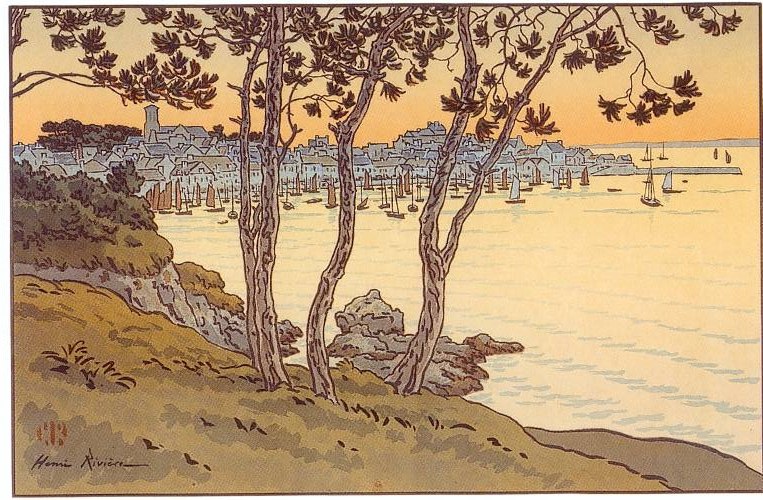
In the later 19th century, at the same time that the fisheries of Douarnenez were booming, so many artists were drawn to the port town of Douarnenez in Brittany  that it came to be called the “Breton Barbizon.” The view from the heights of Ploumarc'h, looking back toward the town, was a favorite theme of many artist.  I am very fond of Henri Rivière's japoniste prints of the 1890s such as this view.
Henri Rivière, The Port of Douarnenez, lithograph, 1893

Artists came to this spot for the view and for the assemblage of everyday life they might encounter:  ships on the bay, the fishing port, young girls herding sheep on its heights, laundresses working, women carrying water from the spring, women and girls watching for the return of the fishing fleet. As is true of most works produced in artists colonies, we seldom have the least inkling that any tourists, artists or other outsiders are present in the landscape.
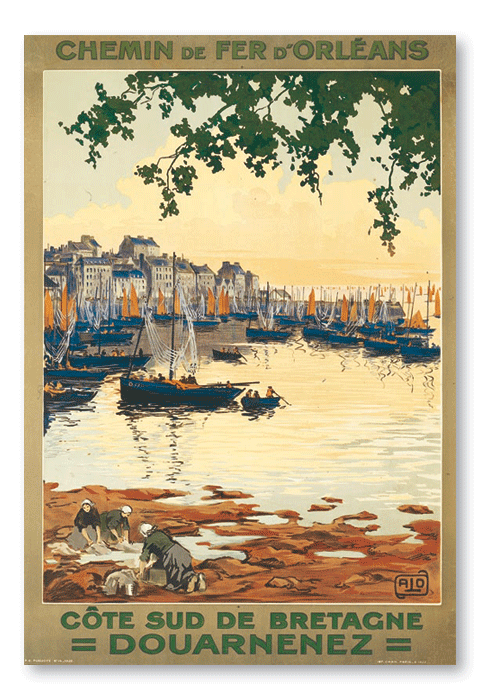
Charles Hallo, Travel poster, c. 1922

Photographs posed for postcards -- only slightly more documentary -- give us some idea of the dirt, the grime, the deprivations of everyday life. Echoing these views, travel narratives from the late 19th century describe the beautiful artistic themes to be found in Douarnenez yet bemoan the pervasive stink, dirty children, untidy homes, fish everywhere.


Tourism is, of course, an experience that involves more than the visual: I am interested in re-imagining bodily experiences of the senses in the visual culture of this area. Some images and narratives offer tourists' complaints about dirt and smell in their encounters with Douarnenez.


   “It is a busy, dirty, and not very attractive town, with one principal street leading down to the port; but walk out of it in any direction, so as to escape the odours of the sardine factories, and the views from the high ground are most rewarding.”
                                                                                Henry Blackburn 1880


Dirt was part of everyday life-- but so was the effort to keep it at bay. The lavoir in Ploumarc'h is marked by a historical plaque that, in French, Breton and English tells the visitor about the day-long washing that women would perform here, with "the dirty working clothes from husband and sons coming back from the sea." This was dirty laundry of a degree almost unfathomable to modern domestic standards-- and it took a day's soaking, scrubbing and wringing to work it out of the clothing.  As many of the women at the lavoir most likely also worked at the sardine canneries in Douarnenez, there was also a great deal of fish filth to be washed out of their own garments.


 In 1865, naturalist painter Jules Breton first visited the Brittany coast and was immediately drawn to its landscape and peasant culture.  What he avoided in his paintings he certainly mentioned in his autobiography:  on his arrival “Douarnenez, whose women and whose beach I had heard so highly extolled, impressed me but little at first”  ….  “But how different everything looked the next day when, after winding our way through a network of fetid  streets permeated with a nauseating odor of sardines,  we suddenly found ourselves in sight of the bay that stretched before us in its dazzling beauty !”


After finding the beaches, he later waxed eloquent in his autobiography about the “exotic” racial differences that he came to appreciate in the women of Douarnenez  “one brings to the mind the dolmens of Celtic  forests, the other the harems of the East.”

Breton,  Spring on the Seashore 1867


Jules Breton, Washerwomen of the Brittany Coast, 1870


 Breton returned many summers to Douarnenez, where one of his favorite themes was that of women washing clothing in a spring by the sea. A young sardine processor, Jeanne Calvet, posed for many of the female figures in Spring on the Seashore (1867) and The Washerwomen of the Breton Coast, (1870). Especially in the 1870 painting, Breton clearly turned his back to the busy fishing town to produce these very successful Salon paintings. This is not unlike the laundresses that Gustave Courbet painted in 1865, working at a spring at low tide in Etretat.


On the beach at at Ploumarc’h was a washing spot where fresh water ran from a stream to meet the sea.  On the cliff above this was the more formal lavoir. Breton may have studied women crouching at the rectangular pool -- scrubbing, wringing and hauling bundles of laundry-- clothing undoubtedly saturated with the indelible stink of fish-- but he posed them at a second washing spot, down on the beach. These women are bleached of the dirt, oil, and odors of their everyday labors, yet this loss of identity or specificity is nothing out of the ordinary when one takes money to pose for an artist.


The artist preferred the exoticism of these strapping yet improbably immaculate barefoot women laundering equally improbably clean – and relatively few garments in this almost natural site. His resulting image of everyday labor has no trace of Douarnenez’s pervasive presence of dead fish, waste, packaged food or, for that matter, global trade, as a sardine worker is transformed into a timeless goddess, enacting a plein air ritual washing of white linen. We have no sense of the grime that women like Jeanne Calvet were trying to remove from their clothes—the oily, sickening smells that clothes take on when one works with fish (and that flow from them in the communal waters).
Breton, undated drawing of a fisherman's wife, Douarnenez.


Post card photographers (who also loved the captive spectacle of women at work -- sometimes bottom up washing clothes outside), likewise, seem to have frequently cruised both spots at Plomarc'h to shoot women at work.


With my represented experience of water gurgling through this site, I’d like to bring back some materiality to Breton’s images, to re-entangle them a bit in Douarnenez.

I work on landscape and place and deeply believe in site visits as research.  This is not to do an art history that tries to  pass judgment on the accuracy of the images, or to argue for recuperating a more socially engaged reading of this academic painter, because I’d like to think about what these paintings DO in this network of the life of a port, not just how they erase or mirror “reality.”

And what can video do?

Water moves through this site; as you watch it and hear it you might perhaps imagine touching its coolness or smelling the mossy banks, or losing a foot's grip on a slippery rock. The water moves through this site, and the water that did move through it brought the laundresses whose dirt moved out and through it, and the painters and photographers came, and watched the laundresses, and they made their images that moved outward into the world, and these images in turn brought later visitors, like me, to this place, to be assembled in contemplation of its materiality.


Tuesday, July 9, 2013

Alexandra Duprez of Douarnenez

I met Alexandra Duprez in Douarnenez in July of 2012.  Toby and I stopped in our tracks at the window of the small gallery, Les Métamorphoses, that she shares with her partner, Jean-Pierre Le Bars, on one of the main streets in Douarnenez.


Homme Ombre Cheval 2011


I was immediately drawn to the indigo blues of patterned dresses, horses, repeated eyes and hands, and wonderful antlers that sprouted from figures.  Flowing heads of hair that become beams of light, empty dresses levitating and sprouting antlers, hand-drawn patterns and webs of color and line.

 Some of my favorite artists came to mind: Kiki Smith, Louise Bourgeois, Annette Messager, Charlotte Salomon, Nancy Spero. A few days later, we saw her again at a small former school house on the edge of the sea in Pors-Poulhan, where she had installed paintings as part of  "L’Art à la Pointe" contemporary art circuit. A few of my photos below are from that show.


Alexandra Duprez has lived in Douarnenez most of her life: she was born there and lives there with her family. What got her painting was not the long history of art in Brittany (her hometown played a large role in the nineteenth century), rather it was a long stay in Australia at the age of 17. Inspired by Aboriginal painting, she returned to France and studied painting at the Fine Arts Academy in Quimper.


Ever since we met in 2012, we have been in touch-- first by email, then she extended a most generous offer for me to visit her in June (2013).  I spent three nights with Alexandra, Jean-Pierre and their three wonderful kids.  How strange to find a friend across the Atlantic who has some of the same obsessions (1960s Danish furniture, Moroccan food, macrame lamps, old crocheted blankets, vintage clothing, indigo).


Cavalier, 2012


Here is her artist's statement (translated with help from Caren Colley-Trowbridge):  
The human figure is central to my work: the figure interacting with elements of various kinds: animal, vegetable...and so on.

These comparisons and contrasts, these juxtapositions and their erasures stage a limited number of fragments of images that I revisit in each painting that I complete, year after year.
Twins, hair, huts, right and left hands, shadows, waves…
Over the course of the past fifteen years, it has occurred to me that I have taken into account many things buried, perhaps forgotten, from the history of images and, undoubtedly, from my own past as well.
 
At the Fort de Sainte Marine in Combrit, Duprez and Le Bars are exhibiting together in the summer of 2013.